
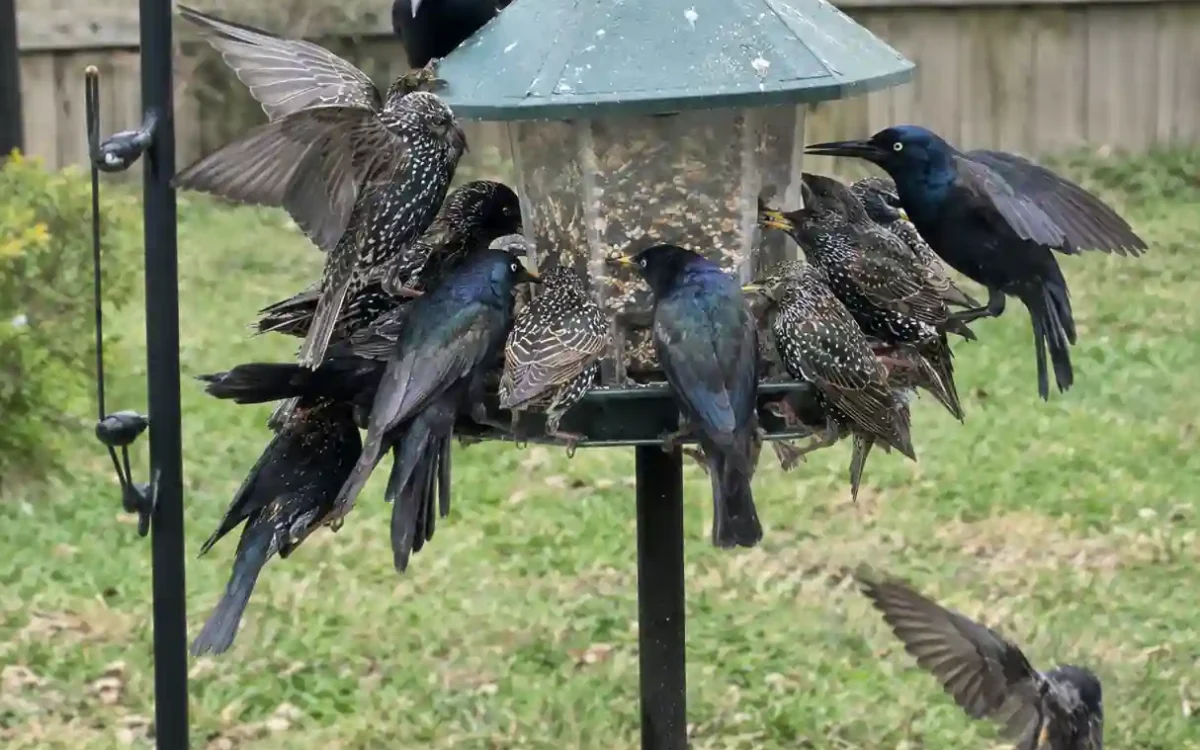
One minute your feeder is full of chickadees and finches, the next a flock has descended and stripped it bare in under ten minutes — leaving nothing but scattered husks and a very quiet yard. If that scene sounds familiar, learning how to keep large birds away from bird feeder setups is less about chasing anything off and more about making your setup simply less convenient for them.
Starlings, grackles, and pigeons aren’t doing anything wrong by feeder standards — they’re just efficient, and that efficiency comes at the expense of the smaller birds you probably set the feeder up for in the first place. Here’s what actually shifts that balance back in your favor.
None of the fixes below require getting rid of birds you don’t want to harm, and none of them need daily effort once they’re set up. It’s mostly a matter of picking the right combination for what’s actually showing up in your yard.
Why Large Birds Suddenly Take Over Your Feeder
If you’re asking why are large birds taking over my bird feeder seemingly overnight, timing is usually the answer. Grackles and starlings travel in mixed flocks and tend to swarm feeders hardest in early spring, when natural food is still scarce but migration and nesting are already underway.
It’s a pattern that catches a lot of backyard birders off guard, mostly because it can look like it came out of nowhere — a feeder that’s been quiet all winter suddenly draws dozens of birds within days of the weather turning.
Understanding why do grackles flock to bird feeders in spring specifically helps set expectations — these visits are often temporary. According to Cornell Lab’s All About Birds, large mixed flocks typically pass through for a limited window rather than settling in permanently, which means the goal isn’t necessarily to eliminate them forever, just to get through the heaviest weeks without losing your smaller visitors.
These mixed flocks often include more than just starlings and grackles — brown-headed cowbirds and red-winged blackbirds tend to travel with them too, which is why a yard can suddenly feel overrun by an entire category of bird all at once rather than just one species arriving gradually.
How to Stop Starlings and Grackles at Your Feeder
The most direct way to address how to stop starlings and grackles at feeder is to change what and how you’re offering food, rather than trying to physically chase birds away, which rarely has lasting results. Switching to straight black oil sunflower or safflower, instead of a cheap mix with filler grains, immediately makes a feeder less appealing to less selective eaters.
This single change alone won’t solve everything if a large flock is already established in the area, but it’s usually the fastest first step, and it costs nothing beyond what you’re already spending on seed.
Some backyard birders also ask does removing the feeder stop starlings — temporarily taking a feeder down for a week or two during a heavy flock passthrough is a legitimate, low-effort option, and the smaller birds you’re used to seeing will generally return once it goes back up.
A decoy strategy also works well: how to use a decoy feeder for unwanted birds simply means setting up a second, cheaper feeder farther from your main station, giving larger birds somewhere easy to go while your primary feeder stays reserved for smaller visitors.
It’s worth being patient with whichever method you choose. Bully birds don’t usually respond to a single change overnight, but combining a seed switch with even one physical barrier — a cage, baffle, or decoy feeder — tends to produce noticeably faster results than relying on just one fix alone.
Choosing Seed That Won’t Attract Blackbirds
Figuring out the best seed to avoid attracting grackles comes down to shell type. Safflower seed to deter blackbirds works particularly well because most blackbirds and grackles dislike its bitter taste, while cardinals, chickadees, and doves still eat it happily.
If you’re also dealing with the closely related question of how to stop blackbirds eating all the bird seed in mixed blends, the fix is usually the same: drop the cheap filler mixes entirely. Milo and cracked corn are magnets for blackbirds specifically, so a straight sunflower or safflower offering solves two problems with one change.
For a broader look at which seed types work best for different backyard visitors, our guide to the best bird seed for backyard birds breaks down exactly what appeals to which species, so you can build a feeding station that favors the birds you actually want to see.
Caged and Weight-Activated Feeders for Small Birds
Physically limiting access solves the problem at the source. Caged bird feeders for small birds work by surrounding the feeding ports with a wire cage wide enough for chickadees and finches to slip through, but too narrow for a grackle or starling to reach.
Weight activated bird feeders for large birds take a different approach — the feeding ports close automatically once something heavier than a songbird lands on the perch. Do baffles work on bird feeders for large birds is a fair question too, and the honest answer is that a low-hanging baffle above a feeder does genuinely discourage birds that dislike feeding under cover, though it works best paired with one of the other methods here rather than alone.
If squirrels are also part of your feeder pressure, the same physical-barrier logic applies — our guide on keeping squirrels away from bird feeders covers cage and baffle setups in more detail.
One small but important detail worth checking carefully before buying: cage diameter matters more than most people initially expect. A cage set too close to the actual feeding ports still lets larger birds stretch their necks and reach the seed, so a wider gap between the outer cage and the feeder itself makes a noticeable difference in how well it actually works.
I visited a neighbor’s backyard during exactly this kind of spring flock event, and what stood out wasn’t the number of grackles — it was how quickly the regular chickadees and finches simply stopped showing up at all, well before the feeder was even empty. Once a caged feeder went up the following week, the smaller birds were back within a few days, almost as if they’d been waiting for an opening.
What I hadn’t expected was how little the actual bird count seemed to matter compared to how the smaller birds reacted. It wasn’t about the grackles eating everything — it was that the songbirds simply avoided the feeder entirely while the larger birds were dominating it, which made the empty yard feel far more dramatic than the seed math alone would suggest.
Dealing With Pigeons and Suet-Stealing Starlings
Ground-feeding species need a slightly different approach. How to stop pigeons from eating bird seed usually means cleaning up spilled seed underneath feeders regularly, since pigeons and doves feed mostly from the ground rather than the feeder itself. A best feeder to keep out pigeons and doves is typically a tube or hopper style set on a pole with a catch tray, which limits how much seed ends up scattered below.
Platform and tray feeders, while popular for attracting a wide variety of species, are usually the worst offenders for pigeon activity, simply because they offer easy open access with nothing to climb or squeeze through. Switching a ground-adjacent platform feeder to a raised tube or hopper style is often enough on its own to cut pigeon visits significantly.
Suet brings its own version of this problem. An upside down suet feeder for starlings works because starlings’ legs aren’t built for hanging upside down for long, while woodpeckers, chickadees, and nuthatches manage it easily. Learning how to keep starlings out of suet feeder setups this way protects your suet supply without needing to change the food itself.
If you’re rethinking your whole feeding station rather than just one feeder, it’s worth stepping back and looking at the bigger picture — our complete guide to feeding backyard birds covers how food, feeder types, and placement work together, which makes it easier to plan a setup that naturally favors smaller species from the start.
| Without a Fix | With a Deterrent Setup |
|---|---|
| Feeder empties in under 30 minutes during flock visits | Same feeder lasts days, even during heavy flock season |
| Seed costs climb from frequent refills | Seed cost drops back to normal once access is limited |
| Smaller songbirds disappear from the yard | Chickadees, finches, and cardinals return within days |
| Daily manual chasing or scaring required | Passive setup — cage, baffle, or seed swap needs no daily effort |
Frequently Asked Questions
What is the best way to keep large birds off a bird feeder?
A caged or weight-activated feeder is usually the most reliable fix, since it physically blocks larger birds while still letting smaller songbirds feed normally.
Does safflower seed really deter grackles and starlings?
For the most part, yes — most blackbirds and grackles find safflower unappealing, though it must be offered on its own rather than mixed with other seed to be fully effective.
Will a caged feeder stop pigeons too?
Usually yes, since pigeons are too large to fit through the cage openings, though they’ll likely still feed on any seed that spills to the ground below.
Should I stop feeding birds altogether if starlings take over?
Not necessarily — temporarily removing the feeder for a week or two during a heavy flock event is a reasonable short-term option, but a permanent switch to caged feeders or safflower usually solves it without stopping feeding entirely.
Are starlings protected by law?
No — starlings, along with house sparrows and pigeons, are non-native species in the US and aren’t protected under the Migratory Bird Treaty Act, unlike most native songbirds.
Why do large birds suddenly swarm my feeder in spring?
Spring flocks of grackles and starlings often pass through while natural food is still limited but migration and nesting activity is picking up, and most move on again within a few weeks.
Which Bird Is Actually Missing From Your Feeder Right Now?
Take a second and think about it honestly — is it the chickadees, the finches, or the cardinals that have quietly stopped showing up since the bigger birds moved in? That’s usually the clearest and quickest sign of exactly which fix to try first.
How to Keep Large Birds Away From Bird Feeder: Key Takeaways

Related Articles
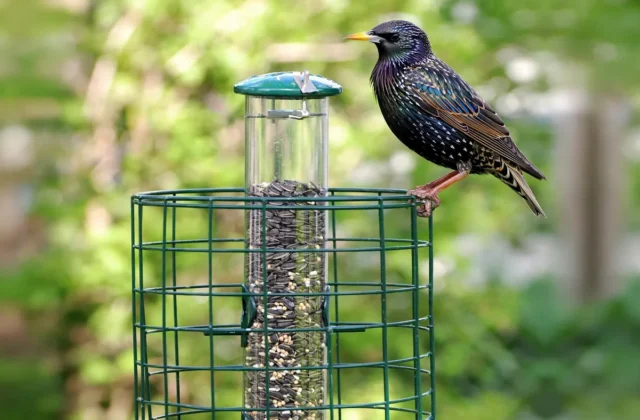
How to Keep Starlings Away From Bird Feeders: 7 Proven Tips (2026)
Nothing empties a bird feeder faster than a flock of European starlings. One minute your tube feeder is…
Read Article
How to Keep Deer Away From Bird Feeders: 7 Proven Ways (2026)
One October morning, coffee in hand, you walk to the back window expecting the usual rush of chickadees…
Read Article
When to Take Down Hummingbird Feeders: 7 Smart Rules (2026)
Every September, I find myself standing at the kitchen window, coffee in hand, staring at my hummingbird feeder…
Read Article