
Last updated: September 24, 2026 · 9 min read
Many beginners start with the cheapest mixed seed from the grocery store, hang the feeder on a random branch, and wait. For weeks, often nothing comes — except a very smug squirrel. It usually takes a season of trial, error, and reading guidance from the Cornell Lab of Ornithology to figure out what works.
Think of this guide as your setup manual and shopping list for feeding backyard birds — which feeders to buy, which seed to stock, where to place everything, and the water, cleaning, and troubleshooting routines that keep it all working year-round. Prefer to learn week by week? Our Bird Feeding for Beginners roadmap walks you through the first 30 days step by step.
How to Feed Backyard Birds: Why It’s Worth It
Beyond the simple joy of watching a goldfinch land six feet from your window, backyard feeding genuinely helps birds — especially in winter and during nesting season when natural food is scarce. The Cornell Lab of Ornithology notes that supplemental feeding can improve winter survival rates for resident birds when done responsibly.
But “responsibly” is doing a lot of work in that sentence. Done wrong, feeders spread disease and attract predators. Done right, your yard becomes a reliable oasis. Let’s do it right.
Step 1: Pick the Right Feeder (Start With Two)
You don’t need a feeder for every species on day one. Start with two complementary feeders:
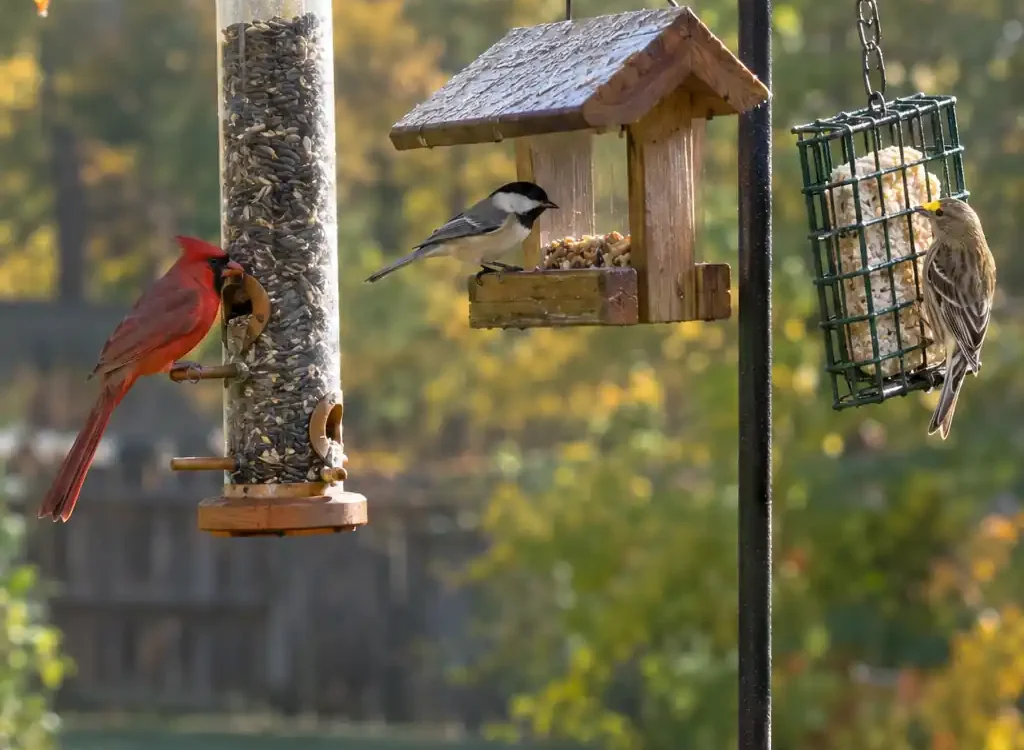
A hopper feeder — the workhorse. It holds a lot of seed, protects it from rain, and welcomes cardinals, jays, finches, chickadees, and more. If you buy only one feeder, make it this one.
A tube feeder (or suet cage) — tube feeders with small perches are goldfinch and chickadee magnets; a suet cage pulls in woodpeckers and nuthatches that rarely visit seed feeders.
Feeder-type chooser
| Feeder type | Best for | Attracts |
|---|---|---|
| Hopper | Beginners, large capacity | Cardinals, jays, finches, chickadees |
| Tube (small perches) | Finches, small songbirds | Goldfinches, chickadees, titmice |
| Platform/tray | Ground-feeding birds | Doves, juncos, sparrows, cardinals |
| Suet cage | Insect-eaters | Woodpeckers, nuthatches, wrens |
| Nectar feeder | Hummingbirds | Hummingbirds, orioles |
For a deeper breakdown, see our guide to choosing the right bird feeder.
Step 2: Buy the Right Seed (This Matters More Than the Feeder)
Here’s the uncomfortable truth: most “wild bird seed mix” bags are bulked out with cheap filler — red milo, wheat, oats — that backyard birds simply won’t eat. It rots on the ground and grows mold.
The two seeds worth your money:
- Black-oil sunflower seeds — the single best all-round seed. High oil content, thin shells, loved by cardinals, chickadees, finches, nuthatches, and more. If you buy one bag, buy this.
- Nyjer (thistle) seed — a finch magnet. Offer it in a dedicated tube feeder with tiny ports.
Good additions: safflower (cardinals love it; squirrels and grackles hate it), shelled peanuts, white proso millet for ground feeders, suet cakes in winter.
Avoid: bread (nutritionally empty and can grow harmful mold), salted nuts, desiccated coconut, and anything moldy or musty-smelling.
Full rankings and a seed-by-species chart are in our best bird food for backyard birds guide.
Step 3: Place Your Feeders Like a Bird, Not a Human
Birds choose feeding spots by one rule: can I eat without being eaten?
- Near cover, not in the open. Place feeders 10–12 feet from shrubs or trees — close enough for a quick escape, far enough that cats can’t ambush.
- Height matters. Hang feeders about 5 feet off the ground.
- Window safety. Either place feeders within 3 feet of windows (birds can’t build up lethal speed) or more than 30 feet away. The in-between zone is where window strikes happen.
- Quiet corners win. Low foot traffic, out of prevailing wind.
More detail: where to hang your bird feeder.
Step 4: Add Water — It’s More Powerful Than Seed
Here’s something most beginner guides bury: clean water attracts more birds than any seed, including species that never visit feeders. A simple shallow birdbath — no deeper than 2–3 inches, with a rough surface for grip — works wonders. In winter, a heated birdbath keeps water ice-free when birds need it most.
Change the water every 2–3 days. Stagnant water breeds mosquitoes and bacteria.
Step 5: Keep Feeders Clean (Non-Negotiable)
Dirty feeders spread salmonella and trichomonosis — diseases that kill finches and other songbirds every year. The research is unambiguous here: a study published in The Wilson Journal of Ornithology (Feliciano et al., 2018) found that soap-and-water alone left enough salmonella on feeders to risk transmission, while a dilute bleach soak eliminated it.
The routine (from Cornell’s Project FeederWatch):
- Empty and dismantle the feeder.
- Scrub with hot soapy water; rinse.
- Soak 10 minutes in a 1:9 bleach-to-water solution.
- Rinse thoroughly and air-dry completely before refilling.
- Repeat every 1–2 weeks; weekly in wet weather or heavy use.
Also rake up hulls and droppings under feeders regularly, and if you ever see a sick bird (puffed up, lethargic, crusty eyes), take feeders down for two weeks and disinfect everything. Our full protocol: how to clean your bird feeders.
Step 6: Be Patient — Birds Need Time to Find You
It can take 2–4 weeks for birds to discover a new feeder. They find food by watching other birds, so the first visitor is the hardest to get. Keep feeders consistently full during this period — an empty feeder teaches birds your yard isn’t reliable.
Once they come, stay consistent. Birds memorize reliable food sources and plan their days around them, especially in winter.
7 Beginner Mistakes to Avoid
- Buying cheap mixed seed full of red milo filler — birds ignore it, it molds.
- One feeder for everything — variety of feeders = variety of birds.
- Placing feeders in the open — birds won’t risk it; give them nearby cover.
- Never cleaning feeders — the #1 way beginners accidentally harm birds.
- Feeding bread — empty calories; can cause a deformity called “angel wing” in waterfowl.
- Putting feeders 10 feet from windows — the worst distance for window strikes.
- Giving up after a week — discovery takes weeks, not days.
What About Squirrels?
Assume squirrels will find your feeders within days — they’re not a surprise, they’re a feature of the hobby. The honest truth (echoed by Birds & Blooms’ own testing): no feeder is 100% squirrel-proof, but baffles, weight-activated perches, and safflower seed cut raids dramatically. Our complete playbook: keep squirrels off your feeders.
Seasonal Quick Reference
- Spring: clean feeders thoroughly; offer nesting material (pet fur, small twigs) nearby.
- Summer: water matters most; clean nectar feeders every 2–3 days; skip suet in extreme heat (it turns rancid).
- Fall: peak migration — keep feeders full; it’s when you’ll see the most variety.
- Winter: high-energy foods (suet, peanuts, black-oil sunflower); never let water freeze if you can help it.
Frequently Asked Questions
How long does it take for birds to find a new feeder? Typically 2–4 weeks. Birds discover feeders by observing other birds, so the first visitor takes longest. Keep the feeder consistently stocked — birds quickly learn which yards are reliable and which aren’t.
What is the best all-round bird seed for beginners? Black-oil sunflower seed. It’s high in oil, easy for most songbirds to crack, and attracts the widest variety — cardinals, chickadees, finches, nuthatches, titmice, and more.
Should I feed birds year-round? Yes — consistency matters more than season. Resident birds like cardinals and chickadees rely on reliable sources year-round. Just adjust: more water in summer, more high-fat foods (suet, peanuts) in winter.
Is it okay to feed birds bread? No. Bread offers almost no nutrition and moldy bread can make birds seriously ill. In waterfowl, junk food diets are linked to “angel wing,” a wing deformity. Stick to seeds, nuts, suet, and fruit.
Do bird feeders attract rats and mice? They can, if seed piles up on the ground. Prevent it: use seed trays to catch spillage, rake under feeders weekly, store seed in sealed metal containers, and never overfill.
When should I take my feeders down? If you see sick birds (lethargic, puffed up, crusty eyes), remove all feeders and baths for at least two weeks, disinfect everything, and rake the area. Also take feeders down if local wildlife agencies report disease outbreaks in your area.
—
Enjoyed this guide? The next step is stocking up properly — see our best bird food for backyard birds rankings, or learn about attracting cardinals to your yard — the most rewarding beginner species of all.
Keep Reading

Related Articles
Winter Bird Feeding Guide: 9 Tips for Cold Months (2026)
Last updated: September 24, 2026 · 8 min read A first January with bird feeders teaches a humbling…
Read Article
Best Mealworms for Backyard Birds: Live vs. Dried Guide
Last updated: September 24, 2026 · 7 min read The best mealworms for backyard birds are the missing…
Read Article
5 Homemade Suet Recipes Birds Love (Easy & Cheap)
Last updated: September 24, 2026 · 7 min read Homemade suet recipes are cheap and easy — but…
Read Article