Skip to content

How to Make Hummingbird Nectar (The Right Ratio and Method)

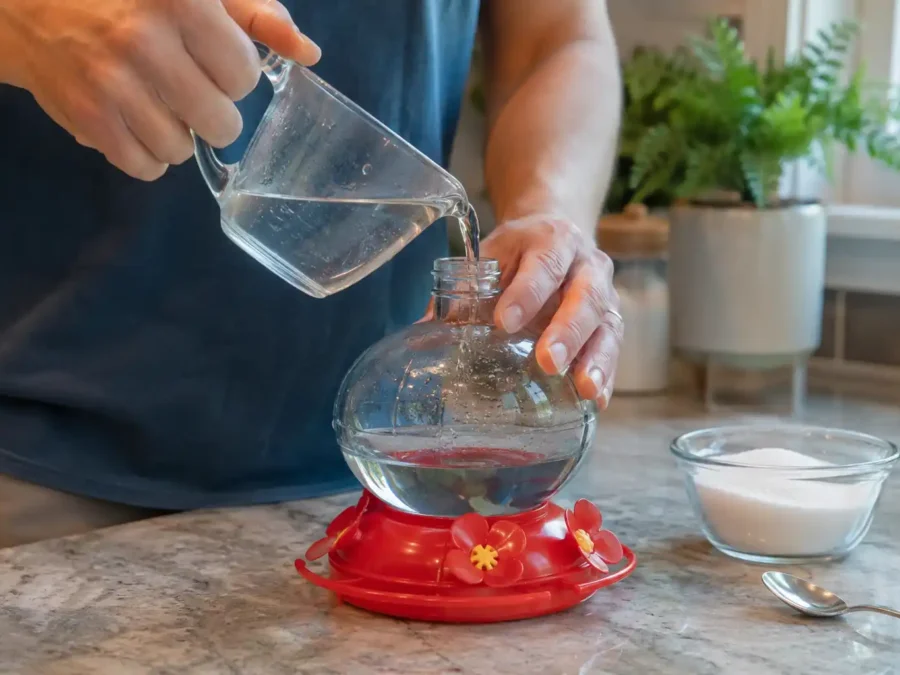
Pouring fresh nectar into a feeder — how to make hummingbird nectar the right way at home
Bird Feeding Note: This article is for general informational purposes. Keep feeders clean, provide fresh food and water, and follow trusted local wildlife guidance when needed.

    Older backyard guides used to recommend red dye, a splash of honey, or store-bought “enhancer” powders mixed straight into the feeder — today, nearly every wildlife organization advises against all three. Knowing how to make hummingbird nectar the right way actually comes down to just two ingredients and one simple ratio, not the long list of extras many people still assume they need. Once the nectar itself is right, the next step is getting birds to actually notice it — our guide on how to attract hummingbirds to a feeder covers exactly that.

    The Right Hummingbird Nectar Ratio (And Why It Works)

    The standard hummingbird nectar ratio is one part plain white sugar to four parts water — a 1:4 mix that roughly matches the sugar concentration found in the flowers hummingbirds naturally feed from.

    If you’re wondering exactly how much sugar for a hummingbird feeder a given batch needs, the math scales evenly: one cup of sugar with four cups of water, or a quarter cup with one cup for a smaller feeder. The unit doesn’t matter as long as both ingredients use the same one for both sides of the ratio.

    Here’s how that breaks down for a few common feeder and batch sizes, so there’s no guesswork with measuring cups:

    Batch SizeSugarWater
    Small feeder 1/4 cup 1 cup
    Standard batch 1 cup 4 cups
    Large / multiple feeders 2 cups 8 cups

    Doubling or halving a batch works cleanly as long as the 1:4 ratio between sugar and water stays fixed.

    Do You Really Need to Boil the Water First?

    Boiling isn’t strictly required, but it does two useful things: it helps the sugar dissolve completely and it removes some impurities from tap water. If you’re looking into how to make hummingbird nectar without boiling, warm tap water stirred thoroughly until the sugar fully disappears works fine for a quick batch.

    Either way, let the mixture cool completely to room temperature before filling a feeder — pouring anything warm in can encourage bacterial growth faster once it’s outside.

    Making It Work Through the Seasons

    The 1:4 ratio holds up well most of the year, but a few seasonal adjustments genuinely help, especially during extreme heat or cold snaps:

    SeasonRatioWhy
    Spring / Summer 1:4 (standard) Matches natural flower nectar concentration
    Extreme heat 1:5 Slightly diluted mix can help deter bees
    Cold snaps / early migration 1:3 Extra energy boost when birds need it most

    These are general guidelines — local climate and hummingbird species can shift the ideal ratio slightly.

    How Long Nectar Actually Lasts (and How to Store It)

    Fresh homemade hummingbird nectar typically stays good in the fridge for about a week, stored in a sealed container. Once it’s in the feeder outside, though, the clock moves much faster.

    In cooler weather, feeder nectar lasts roughly three to five days before it should be swapped out. In hot weather, that window shrinks to two days or even less, since fermentation speeds up significantly above 90°F. Cloudy or noticeably thicker nectar is always a sign to dump it and start fresh, regardless of how many days have passed.

    Signs Your Nectar Has Gone Bad (Don’t Wait for the Calendar)

    Day-counting is a useful starting point, but weather doesn’t follow a fixed schedule, so it helps to know what spoiled nectar actually looks like rather than relying on the date alone.

    • Cloudiness — fresh nectar should stay clear; any haziness usually means fermentation has already started
    • A sour or yeasty smell — nectar shouldn’t smell noticeably different from plain sugar water
    • Visible mold or dark specks — even small amounts mean the whole batch and feeder need a full clean, not just a refill
    • Birds suddenly avoiding a feeder that was previously busy — this is often the earliest sign something’s off, even before anything looks wrong to the eye

    When any of these show up, it’s worth dumping the nectar immediately rather than waiting out the usual refill schedule, since spoiled sugar water can genuinely make hummingbirds sick.

    What About Nectar Additives, Vitamins, and Boosters?

    Store shelves are full of powders and liquid additives promising extra energy, added vitamins, or faster attraction — and it’s worth understanding what these products actually do before adding one to a mix.

    In the wild, hummingbirds get the bulk of their nutrients from small insects and pollen, not from nectar alone, which is naturally just sugar and water. Most wildlife organizations note that a plain 1:4 sugar-water mix already meets a hummingbird’s energy needs, and there’s no strong evidence that added vitamins in a feeder provide any real benefit beyond what a healthy, insect-eating bird already gets on its own.

    That doesn’t make every additive harmful, but it does mean a simpler homemade hummingbird nectar recipe is rarely missing anything important. If cost or convenience is the main draw of pre-made products, that’s a reasonable enough reason on its own — just know the plain version isn’t the “budget” version, it’s the standard one.

    Can You Freeze Extra Nectar for Later?

    If a single batch makes more than a week’s worth of refills, freezing is a genuinely practical option that a lot of guides skip over entirely. Nectar freezes well in an airtight container or, even more conveniently, in a standard ice cube tray.

    Once frozen, the cubes can be popped out and stored in a freezer bag for up to a couple of months. Thawing one or two cubes at a time in the fridge overnight gives just enough for a single refill without having to mix a fresh batch every few days or let a large container sit too long in the fridge.

    This approach works especially well heading into a busy season, since it turns one afternoon of mixing into weeks of ready-to-use nectar without any extra effort on refill day.

    Common Mistakes That Quietly Drive Hummingbirds Away

    A few habits show up again and again in backyard setups, and most of them are easy to fix once you know to look for them.

    • Using honey or brown sugar instead of plain white sugar — both can ferment quickly and are genuinely unsafe for hummingbirds
    • Adding red food dye, which offers no real benefit and isn’t something birds actually need to find a feeder
    • Using well or bottled mineral water instead of regular tap water, which can throw off the mineral balance unnecessarily
    • Filling a feeder to the very top when only a small amount gets used each day — smaller, more frequent batches waste far less nectar than one large fill that sits too long
    • Skipping a full clean between refills, even when the feeder still looks empty and fine — leftover residue at the bottom spoils new nectar faster than people expect

    Spilled or overflowing nectar during a refill is also one of the most common causes of an ant trail forming on a feeder pole — our guide on how to keep ants out of a hummingbird feeder covers exactly how to prevent that. And leftover residue from old nectar is one of the fastest ways a feeder gets dirty between refills, which is where our full guide on how to clean a hummingbird feeder comes in handy.

    Field Visit

    While researching this guide, I spent an afternoon at a local nature reserve talking with a volunteer who manages nearly a dozen feeders across the property. What stood out most was how much simpler her routine was compared to what most online guides describe.

    She mixes nectar in a single large batch once a week, stores it in labeled jugs in a fridge, and refills feeders from that supply every two to three days rather than making fresh batches each time. It wasn’t a complicated system — just a consistent one, which seemed to matter more than any specific trick.

    Frequently Asked Questions

    Can I use brown sugar for hummingbird nectar?+

    No, brown sugar contains molasses and trace minerals that aren’t safe for hummingbirds in regular amounts. Plain white granulated sugar is the only recommended option.

    Do I need to boil the water for hummingbird nectar?+

    It’s not strictly required, but boiling helps the sugar dissolve fully and can remove some tap water impurities. Just make sure the mixture cools completely before filling a feeder.

    Is tap water safe for hummingbird nectar?+

    Yes, regular tap water is fine for most households and is actually preferred over distilled or mineral water, which can lack the balance hummingbirds are used to.

    How long can homemade nectar sit in the fridge?+

    A fresh batch typically keeps for about a week in a sealed container in the refrigerator, making it easy to prepare one batch and refill feeders from it over several days.

    Does the nectar ratio change with the seasons?+

    Slightly, yes. The standard 1:4 ratio works for most of the year, though a stronger 1:3 mix can help during cold snaps, and a lighter 1:5 mix is sometimes used in extreme summer heat.

    ?

    What’s actually in your feeder right now?

    If it’s been more than a few days since you last checked, there’s a decent chance it’s time for a fresh batch — getting how to make hummingbird nectar right is really just a habit of staying consistent, not chasing the perfect recipe. A quick glance today could be the difference between a feeder that’s quietly going stale and one that’s genuinely ready for its next visitor.

    Share

    FAISAL REHMAN

    Writer and researcher at Bird Feedly, covering bird feeding, bird food, feeders and backyard birding.

    Leave a Comment

    Your email address will not be published. Required fields are marked *