
Last updated: September 24, 2026 · 7 min read
This isn’t a cats-vs-birds screed; it’s a practical guide on how to keep cats away from bird feeder. The science is stark — Smithsonian and American Bird Conservancy research estimates free-roaming cats kill roughly 2.4 billion birds annually in the US alone — but the solutions are humane, effective, and mostly about design, not conflict.
Disclosure: Bird Feedly is reader-supported. When you buy through links on our site, we may earn an affiliate commission at no extra cost to you.
First, Two Myths to Retire
“Well-fed cats don’t hunt.” False — hunting is instinctual, not hunger-driven. Studies show fed cats hunt just as much; they just eat less of what they catch.
“A bell on the collar solves it.” Mostly false — cats learn to stalk without ringing bells, and research shows bells reduce kills only modestly. Better than nothing, not a solution.
How to Keep Cats Away From Bird Feeder: 8 Methods, Ranked by Impact
1. Elevate and isolate feeders (High impact, easy)
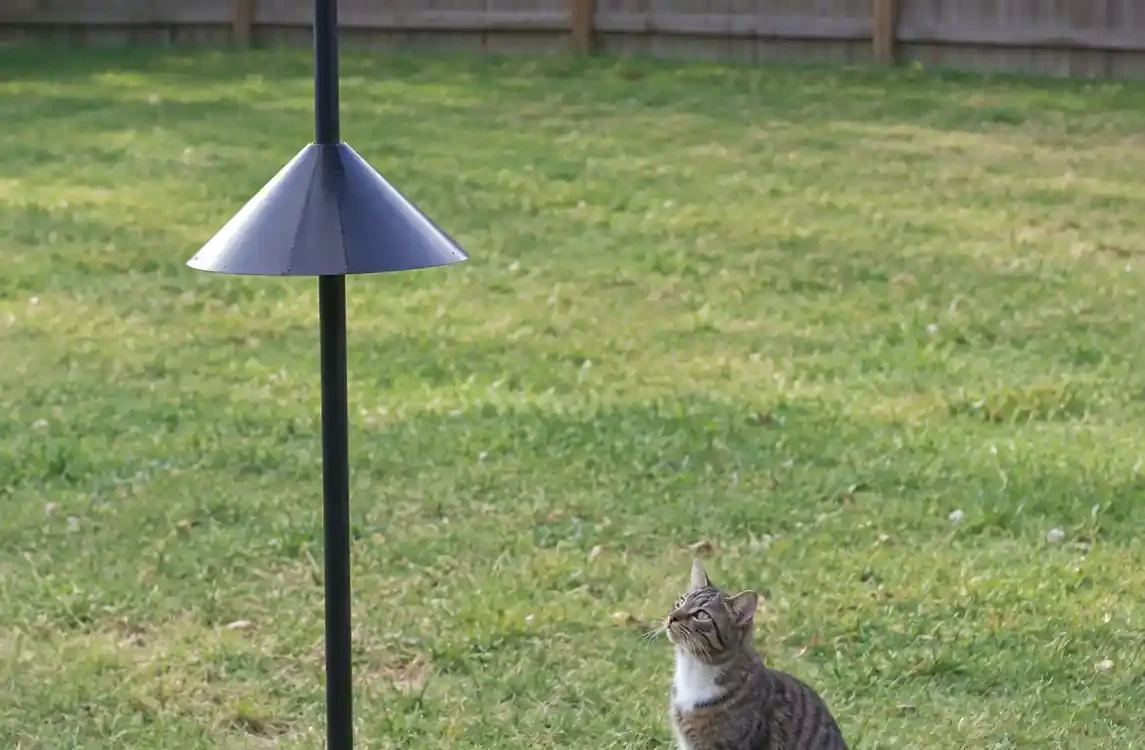
Pole-mounted feeders at 5–6 feet with 10+ feet of open space around them deny ambush cover. Ground-feeding areas should be in the open, never against dense shrubs cats hide in.
2. Remove ambush cover near feeders (High impact, easy)
Trim low shrubs within ~10 feet of feeding zones. Cats need concealment for the final pounce — open sightlines let birds spot them early. Keep escape cover (taller shrubs) at 10–15 feet: close enough to flee to, too far to pounce from.
3. Keep cats indoors / build a catio (Highest impact, lifestyle change)
The only method with near-total effectiveness. Indoor cats live longer too — outdoor cats face cars, disease, and fights. A catio (enclosed patio) gives cats outdoor enrichment with zero bird toll. If you own cats, this is the answer.
4. Cat-proof fencing (High impact, moderate cost)
Roller-bar or angled-mesh toppers on fences keep cats in (yours) or out (neighbors’). Several commercial systems exist; they’re the standard solution in the UK, where this debate is decades old.
5. Motion-activated deterrents (Medium impact, easy)
Motion-sensor sprinklers startle cats without harm and work 24/7. Ultrasonic deterrents have mixed reviews — sprinklers are the reliable pick. Position covering feeder approaches, not the feeders themselves.
6. Collar covers: CatBibs (Medium impact, easy)
Unlike bells, CatBibs (a neoprene flap hanging from the collar) physically interfere with the pounce timing. Studies show meaningful kill reduction. For a neighbor’s cat you can’t contain, gifting a CatBib is a friendly, concrete ask.
7. The neighbor conversation (Variable impact, free)
Most cat owners genuinely don’t know the scale of the toll. A script that often works: lead with shared love of animals, share the 2.4-billion figure briefly, then offer solutions (catio ideas, CatBib gift) rather than demands. Accusation hardens positions; collaboration changes behavior.
8. Supervised outdoor time (Medium impact, lifestyle)
Harness walks and leash time give cats outdoor enrichment under control. Not every cat takes to a harness, but many do with patient training.
What About Water Features?
Baths and ponds concentrate birds — and therefore cat interest. Apply the same rules: open sightlines, no ambush cover adjacent, elevated where possible. See bird bath placement for the specifics.
Frequently Asked Questions
How many birds do cats kill each year? Research published by the Smithsonian Conservation Biology Institute and the American Bird Conservancy estimates free-ranging domestic cats kill 1.3–4.0 billion birds annually in the US, with ~2.4 billion as the central estimate — making cats the top human-caused threat to birds.
Do bells on cat collars prevent hunting? Only modestly. Cats adapt their stalking to minimize bell noise, and studies show limited reduction in kills. Collar covers like CatBibs, which physically disrupt the pounce, perform better — but keeping cats indoors outperforms everything.
How do I keep my neighbor’s cat out of my yard? Combine deterrence (motion-sensor sprinklers, cat-proof fence toppers) with diplomacy (share the science kindly, gift a CatBib, suggest catio ideas). Avoid trapping or harming the cat — it’s ineffective long-term and poisons the relationship.
Should bird feeders be high off the ground to deter cats? Yes — 5–6 feet on a pole with open space around it is the standard. Ground-feeding should happen in open areas with escape cover 10–15 feet away, never tucked against dense shrubs where cats hide.
Is it safe to use mothballs or chemicals to repel cats? No — mothballs are toxic to birds, pets, and children, and illegal for outdoor use in many places. Stick to physical and behavioral deterrents: barriers, sprinklers, placement, and containment.
You don’t have to choose between loving cats and protecting birds — you just have to design for both. Contain the cats, open up the sightlines, and your feeders become the safe haven they were meant to be.
Keep Reading
- feeder placement guide
- bird bath placement
- baffled pole systems
- bird-friendly yard
- helping an injured bird

Related Articles
How to Keep Starlings Away From Bird Feeders: 7 Proven Tips (2026)
Nothing empties a bird feeder faster than a flock of European starlings. One minute your tube feeder is…
Read Article
How to Keep Deer Away From Bird Feeders: 7 Proven Ways (2026)
One October morning, coffee in hand, you walk to the back window expecting the usual rush of chickadees…
Read Article
When to Take Down Hummingbird Feeders: 7 Smart Rules (2026)
Every September, I find myself standing at the kitchen window, coffee in hand, staring at my hummingbird feeder…
Read Article