
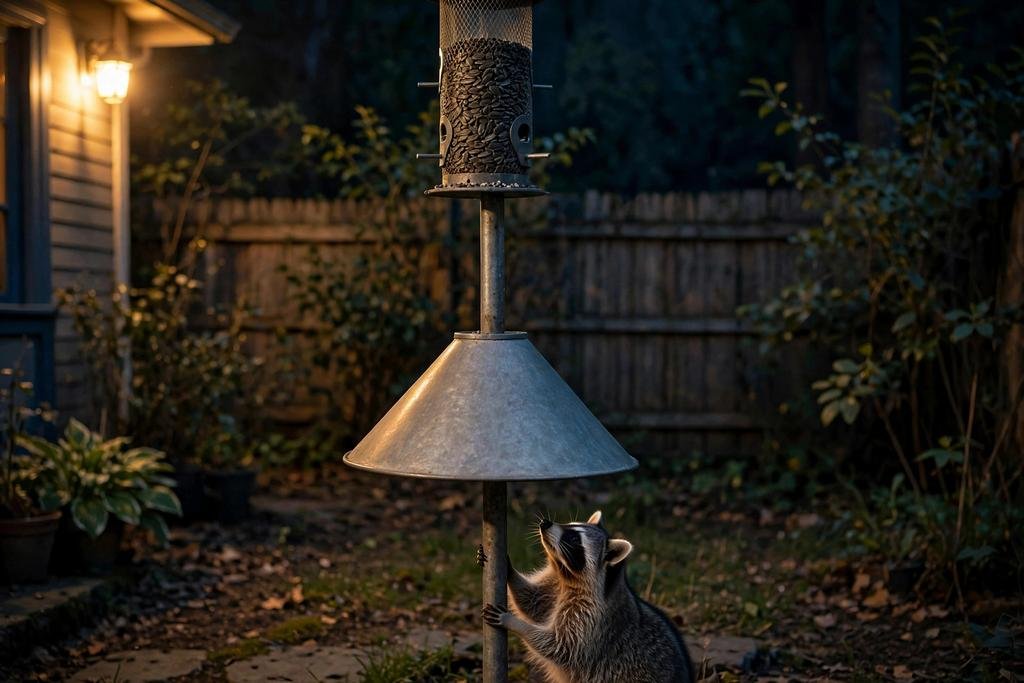
I filled my feeder to the top one evening, proud of how happy the birds had been all day. Next morning? Completely empty — seed scattered everywhere, the suet cage hanging crooked, and little muddy paw prints on the deck railing. A raccoon had thrown a midnight party at my expense.
If you want to know how to keep raccoons away from bird feeders, I have good news: after two seasons of trial and error, I found what actually works — and what is a waste of money. Here are the 7 methods I trust, starting with the one that never fails.
Why Raccoons Love Your Bird Feeder
Understanding the enemy helps. Raccoons are nocturnal, so they do their raiding between dusk and dawn while you sleep. Their front paws are incredibly dexterous — they can unlatch simple feeder lids, untie knots, and tip over anything that isn’t secured. And in fall, they are desperately bulking up for winter, which is why September and October are peak feeder-raid season.
The key insight: you don’t need to fight raccoons around the clock. You just need to make your feeder harder to rob than the neighbor’s.
7 Proven Ways to Keep Raccoons Away from Bird Feeders
1. Bring Your Feeders In at Night (My #1 Method)
This is the single most effective thing you can do, and it’s free. Raccoons feed at night; birds feed during the day. So every evening, I take my hanging feeders down and store them in a sealed metal bin in the garage, then hang them back up in the morning.
Yes, it takes two minutes of effort. But in the three months I did this consistently, I had zero raccoon visits. The Humane Society of the United States recommends exactly this approach, and I can confirm it works. If you do nothing else on this list, do this.
My routine: feeders come down at sunset, go back up with my morning coffee. It becomes a habit fast.
2. Install a Raccoon Baffle on the Pole
If bringing feeders in nightly sounds like too much work, a baffle is your best hardware investment. A baffle is a cone or cylinder that wraps around the feeder pole and physically blocks climbing animals.
- Cone baffles (at least 18 inches wide) deflect raccoons outward so they can’t reach around them.
- Cylinder/tube baffles spin when a raccoon grabs them, throwing the animal off balance.
Mount the baffle at least 4 feet off the ground so the raccoon can’t jump over it from below. I use a cone baffle on my main pole feeder, and combined with smart placement (tip #3), it has stopped every climbing attempt I’ve seen. This is the same principle behind how I keep squirrels away from my bird feeders — baffles work on both.
3. Fix Your Feeder Placement (The 10-Foot Rule)
Most people hang feeders too close to “launch pads.” Raccoons can climb trees, fences, sheds, and deck railings, then leap or stretch onto the feeder. Follow these placement rules:
- Keep feeders at least 10 feet away from trees, fences, roofs, and railings.
- Use a smooth metal pole at least 5–6 feet tall — poles thinner than half an inch in diameter are very hard for raccoons to climb.
- Hang feeders in open areas where raccoons feel exposed.
I moved one of my feeders from a tree branch (a raccoon highway) to a standalone pole 12 feet from the nearest fence, and the night raids on that feeder stopped immediately. If you’re unsure about positioning, read my guide on where to place a bird feeder — placement solves more problems than any gadget.
4. Switch to a Weight-Activated or Caged Feeder
Raccoons are heavy — most weigh 10 to 20 pounds. Weight-activated feeders use that against them: when anything heavier than a large bird lands on the perch, the feeding ports snap shut. Birds eat normally; raccoons get nothing.
Caged feeders work on the same idea with a different design — a wire cage surrounds the feeding tube. Small birds slip through easily, but raccoon paws can’t reach the seed inside.
These feeders cost more upfront, but mine paid for itself in about two months just in saved seed. A raccoon can eat several hundred calories of seed in a single visit, so the math adds up fast.
5. Clean Up Spilled Seed Every Evening
Here’s what most people miss: even a perfectly raccoon-proof feeder still attracts raccoons if seed is scattered on the ground beneath it. Spilled seed is an all-you-can-eat buffet that teaches raccoons to keep coming back.
Every evening I do a 60-second sweep under my feeders with a small broom. I also switched to a no-mess seed blend — the best bird seed for backyard birds in my experience is one without filler shells that birds toss aside. Less waste on the ground means fewer midnight visitors. A seed-catcher tray under the feeder helps too.
6. Feed Only What Birds Finish by Dusk
This pairs perfectly with tip #1. Instead of filling feeders to the brim, I put out roughly what my birds eat in a day. By evening, the feeders are nearly empty — there’s simply nothing left worth raiding.
It took me about a week to learn the right daily amount for my yard (for me, it’s about 2 cups of black-oil sunflower seed across three feeders). Start by filling halfway, watch how fast it goes, and adjust. Bonus: fresher seed every day, which the birds clearly prefer.
7. Use Cayenne Pepper and Motion Deterrents
Here’s a fact I love: birds cannot taste capsaicin — the compound that makes chili peppers hot — but mammals absolutely can. Mixing a teaspoon of cayenne pepper into your seed (or buying pre-treated “hot” seed) makes every bite unpleasant for raccoons while birds don’t notice a thing.
For extra protection, I also use a motion-activated sprinkler near my ground-feeding area. The sudden burst of water startles raccoons without harming them. Motion-activated lights help a little, but raccoons get used to them within a week or two, so don’t rely on lights alone.
Raccoon Deterrent Methods Compared
| Method | Cost | Nightly Effort | Effectiveness |
|---|---|---|---|
| Bring feeders in at night | Free | 2 minutes | ★★★★★ |
| Pole baffle (cone/cylinder) | $15–$30 once | None | ★★★★☆ |
| 10-foot placement rule | Free | None | ★★★★☆ |
| Weight-activated feeder | $40–$80 once | None | ★★★★☆ |
| Daily seed cleanup | Free | 1 minute | ★★★☆☆ |
| Cayenne pepper in seed | ~$5/month | Minimal | ★★★☆☆ |
| Motion-activated light/sprayer | $25–$50 once | None | ★★☆☆☆ |
My recommendation: combine the free methods (1, 3, 5, 6) first. Add a baffle if you want a set-and-forget solution. That combination has kept my feeders raccoon-free for two full seasons.
6 Common Mistakes to Avoid
- Using poison. It is indiscriminate — it can kill birds, pets, and protected wildlife, and it is illegal in many areas. Never worth it.
- Greasing the pole. Grease washes off in rain, and worse, it can coat birds’ feathers and damage their ability to fly and stay warm.
- Trapping and relocating. In many states this requires a permit or is outright illegal, and relocated raccoons usually die or find their way back. It also just opens the territory for a new raccoon.
- Relying only on motion lights. Raccoons habituate fast. Lights alone buy you about a week.
- Leaving feeders full overnight. A brimming feeder is an invitation. Feeders should be near-empty by dusk.
- Using mothballs. They don’t reliably repel raccoons, and they’re toxic to soil, water, and wildlife. Skip them.
One more thing worth knowing: a sudden raccoon problem can also explain birds suddenly stopped coming to your feeder — birds avoid feeders that smell like predators. Solving the raccoon issue often brings the birds right back.
Frequently Asked Questions
Will cayenne pepper hurt the birds?
No. Birds lack the receptors that detect capsaicin, so they literally cannot taste the heat. Mammals like raccoons and squirrels feel the full burn, which is exactly why it works as a selective deterrent. Just avoid getting the dust in your own eyes when mixing.
What time do raccoons raid bird feeders?
Almost always between dusk and dawn, with peak activity in the first few hours after dark. If your feeder is full at sunset and empty at sunrise, a nocturnal raider — most likely a raccoon — is your culprit. This is also why bringing feeders in at night is so effective.
Will a squirrel baffle stop raccoons too?
Often yes, if it’s sturdy and wide enough. Raccoons are heavier and stronger than squirrels, so choose a heavy-duty metal baffle at least 18 inches wide rather than a flimsy plastic one. Mount it 4+ feet off the ground on a smooth metal pole for best results — the same setup I describe in my guide on rats and mice raiding bird feeders.
Can raccoons climb a greased pole?
They can, and you shouldn’t try it. Grease washes away quickly and can transfer onto birds’ feathers, harming their insulation and flight. A proper baffle on a smooth metal pole is safer, legal, and far more effective.
Is it legal to trap a raccoon raiding my feeder?
It depends entirely on where you live — many states require a permit, and relocation is illegal in quite a few. Even where legal, it’s ineffective: another raccoon simply moves into the empty territory. Exclusion (baffles, placement, nightly removal) works better and keeps you on the right side of the law.
Do raccoons come out during the day?
Healthy raccoons are strictly nocturnal. If you see one active in daylight, especially if it looks disoriented or unusually bold, keep your distance and contact local animal control — daytime activity can occasionally signal illness such as rabies or distemper.
Why did raccoons suddenly start raiding my feeder this fall?
Fall is peak raiding season. Raccoons are instinctively fattening up for winter and need far more calories than in summer. A feeder they ignored in July becomes irresistible in September. This is the most important time of year to bring feeders in at night and keep spilled seed cleaned up.
The bottom line: you don’t need expensive gadgets or harsh chemicals to win this fight. Bring feeders in at night, place poles 10 feet from anything climbable, add a baffle, and keep the ground clean. That’s the exact system I use, and my seed bill — and my sleep — have never been better.

Related Articles
How to Keep Starlings Away From Bird Feeders: 7 Proven Tips (2026)
Nothing empties a bird feeder faster than a flock of European starlings. One minute your tube feeder is…
Read Article
How to Keep Deer Away From Bird Feeders: 7 Proven Ways (2026)
One October morning, coffee in hand, you walk to the back window expecting the usual rush of chickadees…
Read Article
When to Take Down Hummingbird Feeders: 7 Smart Rules (2026)
Every September, I find myself standing at the kitchen window, coffee in hand, staring at my hummingbird feeder…
Read Article