
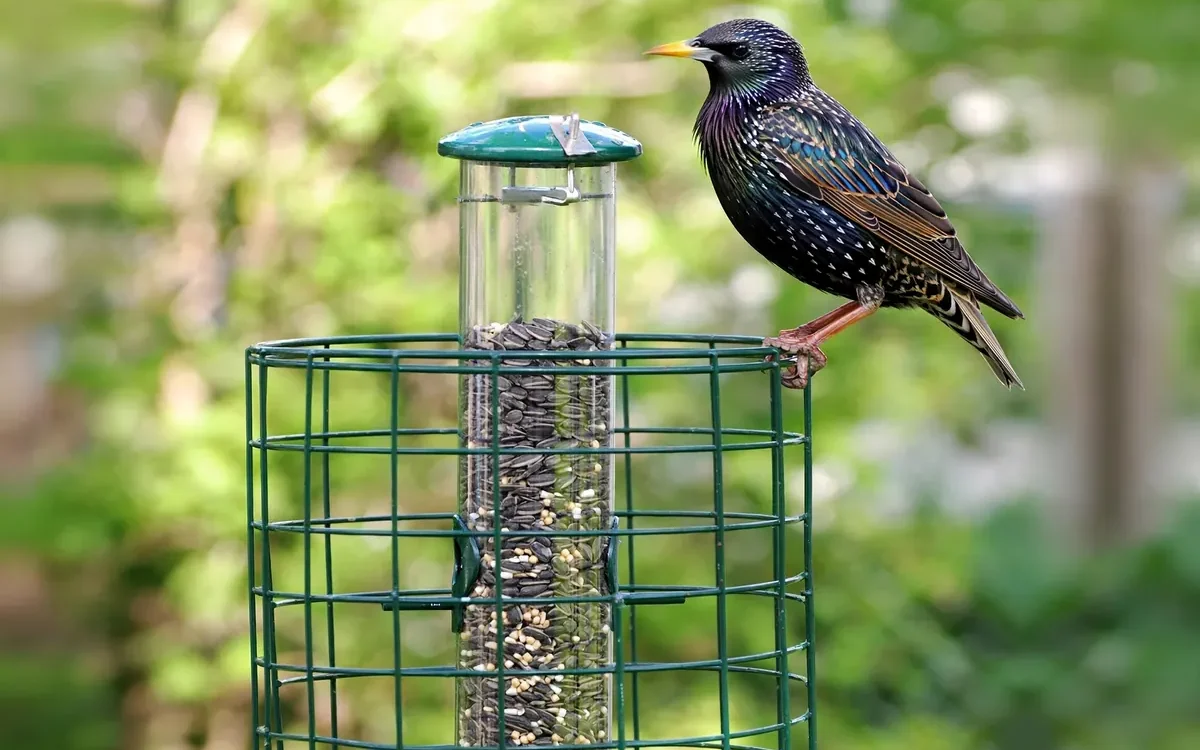
Nothing empties a bird feeder faster than a flock of European starlings. One minute your tube feeder is full of black oil sunflower seed, and the next, twenty glossy black birds have shouldered every chickadee and finch aside and vacuumed the whole thing clean. If you want to learn how to keep starlings away from bird feeders without giving up feeding birds altogether, you are in the right place. The good news is that you do not have to choose between feeding birds and feeding starlings — with the right feeder designs, seed choices, and placement tricks, you can welcome the birds you love while making your setup deeply unappealing to starlings.
Why Starlings Are So Hard to Beat
European starlings (Sturnus vulgaris) are one of North America’s most successful invasive birds. First released in New York’s Central Park in the 1890s, they have grown into a population the Cornell Lab of Ornithology estimates at around 200 million birds. They travel in loud, coordinated flocks, eat almost anything, and bully smaller songbirds away from feeders through sheer numbers.
But starlings have weaknesses, and every tip below exploits one of them. Their bills are soft and pointed — great for probing soil, terrible for cracking hard shells. They are clumsy at clinging upside down. They dislike bitter-tasting seed. And they are creatures of habit: break the habit, and the flock moves on. Here is how to do it.
1. Switch to a Caged Feeder
The single most effective starling defense is a caged feeder: a tube or hopper feeder wrapped in a wire cage with openings around 1.5 inches wide. Small birds like chickadees, titmice, and finches slip right through the bars, while bulky starlings cannot fit and cannot reach the seed ports from outside.
I recommend starting here because it works around the clock with zero effort from you. Once the cage is up, desirable birds learn the new setup within a few days, and starlings learn even faster that this feeder is not worth their time. If you already enjoy watching chickadees at your feeders, a caged feeder is perfect — chickadees are among the first birds to figure out cage openings.
2. Hang an Upside-Down Suet Feeder
Starlings adore suet and can strip a standard suet cake in under half an hour. The fix is beautifully simple: hang your suet feeder upside down, so birds must cling beneath it and feed facing upward. Woodpeckers, nuthatches, and chickadees are natural upside-down clingers. Starlings are not — they fumble, flap, and give up.
You can buy ready-made upside-down suet feeders, or convert a standard cage-style suet feeder by hanging it horizontally under a baffle. Keep one regular suet feeder for woodpeckers if you like, but make your main suet station the upside-down kind during peak starling season in spring and summer.
3. Serve Seeds Starlings Dislike
Starlings are picky in one useful way: they avoid foods that are hard to open or unpleasant to taste. Build your menu around these starling-resistant foods:
- Safflower seed — slightly bitter; cardinals, grosbeaks, and chickadees love it, starlings avoid it.
- Nyjer (thistle) seed — tiny seed in tiny ports that starlings cannot use; a finch magnet.
- In-shell peanuts — starlings’ soft bills cannot crack the shells; jays and woodpeckers manage fine.
Just as important is what you stop serving in open feeders: cracked corn, millet-heavy cheap mixes, bread scraps, and loose shelled peanuts are starling favorites. If you are rethinking your seed lineup, my guide to choosing the right bird seed breaks down which seeds attract the birds you want.
4. Clean Up Spilled Seed
Starlings are enthusiastic ground foragers — a pile of spilled seed under your feeder is an open invitation. Rake or sweep beneath feeders regularly, and consider adding a seed tray or saucer under tube feeders to catch what falls. Less waste on the ground means fewer reasons for a flock to settle in.
This habit pulls double duty: spilled, damp seed also grows mold and spreads disease among feeder birds. A regular cleanup routine is one of the foundations of keeping bird feeders clean and safe, and it quietly makes your yard less attractive to starlings at the same time.
5. Use Weight-Activated or Short-Perch Feeders
Starlings are noticeably heavier than chickadees and finches, and feeder designers have turned that against them. Weight-activated feeders close their seed ports when a heavy bird lands — the same mechanism that frustrates squirrels works beautifully on starlings. Many models let you calibrate the trigger weight so medium birds like cardinals can still feed.
Short-perch tube feeders work on a similar principle: perches just an inch or two long give small birds a foothold while leaving starlings with nothing comfortable to grip. If you have ever looked into weight-activated and squirrel-proof feeder designs, you will find the same feeders solve your starling problem too.
6. Rethink Where You Hang Your Feeders
Placement matters more than most people expect. Starlings like to stage an attack: they gather on a nearby branch, fence, or wire, survey the feeder, then descend en masse. Hang feeders in open spots away from convenient staging perches, and the flock loses its coordination advantage.
Two more placement tricks help. First, hang feeders under a wide dome baffle or eave — the overhead cover makes it awkward for starlings to drop in from above. Second, keep some feeders within a few feet of your house; starlings are warier of feeding close to buildings than many songbirds are. As always, where you hang your feeders shapes everything about who visits them.
7. Give Your Feeders a Short Break
If a flock has already claimed your yard as its personal buffet, the nuclear option is also the simplest: take your feeders down for one to two weeks. Starlings are opportunists, not loyalists. With no easy food, the flock moves on to better territory — while your chickadees and titmice, which forage more widely, will rediscover the feeders within a day or two of their return.
Time this break for when you will be busy anyway, and use the downtime to scrub your feeders. When you rehang them, come back with a caged feeder or a safflower-heavy menu from the tips above, so the starlings return to a yard that no longer welcomes them. For a full playbook on dealing with other uninvited guests, my raccoon-proofing guide follows the same humane-deterrence philosophy.
Quick-Reference: Starling Deterrents at a Glance
Here is the full toolkit for how to keep starlings away from bird feeders in one glance — mix and match the methods that fit your setup:
| Method | Why It Works | Best For |
|---|---|---|
| Caged feeder | Bars block bulky starlings, admit small birds | Tube and hopper feeders |
| Upside-down suet feeder | Starlings cannot cling upside down | Suet cakes |
| Safflower, nyjer, in-shell peanuts | Bitter, tiny, or too hard for soft bills | Seed menu overhaul |
| Clean up spilled seed | Removes ground-foraging incentive | Under every feeder |
| Weight-activated feeder | Ports close under a starling’s weight | High-traffic stations |
| Short perches | Denies starlings a comfortable grip | Tube feeders |
| Smart placement | No staging perches, overhead cover | Whole feeding station |
| 1–2 week feeder break | Breaks the flock’s habit | Heavy infestations |
5 Mistakes to Avoid
1. Buying a plastic owl and calling it done. Starlings figure out motionless decoys within days. If you use visual deterrents, move them daily and combine them with real feeder changes.
2. Filling open trays with cheap millet and corn mixes. This is essentially a starling buffet. Save the mixed seed for starling-proof feeders or switch to safflower.
3. Ignoring the ground. Even the best caged feeder will not help if a drift of spilled seed underneath feeds the flock for free.
4. Taking feeders down permanently. A short break resets starling habits; a permanent takedown just punishes the birds you actually want. Come back with better defenses instead.
5. Using poisons, sticky repellents, or violent traps. These harm every bird that visits — including the ones you love — and most are illegal or restricted in many areas. The National Audubon Society’s field guide notes the starling’s real ecological cost; the answer is smarter feeding, not harming birds. Stick to humane deterrence.
The Bottom Line
You do not have to surrender your feeders to the flock. If you have been wondering how to keep starlings away from bird feeders without harming any bird, this combination is the answer: exclusion feeders, starling-proof foods, and smart placement. Start with the highest-impact changes — a caged feeder, safflower seed, and a cleanup routine — and add the rest as needed. Within a couple of weeks, you will notice the difference: the same feeders, the same yard, but the birds at the ports will be the chickadees, finches, and cardinals you actually hung them for. That is a backyard worth feeding.
Why do starlings come to my bird feeder?
Starlings are opportunistic flock feeders with a taste for easy calories. Open feeders full of suet, millet, cracked corn, or shelled peanuts are effortless food, and once a few birds find yours, the flock follows. They are also cavity-nesting urban adapters, so suburban yards are prime territory.
What food do starlings hate?
Starlings strongly dislike safflower seed (bitter taste), nyjer seed (too small to use), and in-shell peanuts (their soft bills cannot crack the shells). Switching your open feeders to these foods is one of the fastest ways to reduce starling visits while keeping cardinals, finches, and chickadees happy.
Will starlings scare away other birds?
Yes. Starlings arrive in large, noisy flocks and physically dominate feeders, which drives away smaller songbirds like chickadees, titmice, and finches. They also eat astonishingly fast — a flock can empty a suet cake or seed feeder in well under an hour, leaving nothing for anyone else.
Are European starlings protected by law?
In the United States, European starlings are not protected under the Migratory Bird Treaty Act because they are a non-native invasive species. Even so, humane deterrence — better feeders, smarter seed choices, and placement — is the responsible approach and the one these tips are built around.
How long should I take my feeders down to get rid of starlings?
One to two weeks is usually enough. Starlings are opportunists and will relocate to better food sources within days. Your regular songbirds forage across a wider area and typically return within a day or two after you rehang the feeders — ideally with starling-resistant upgrades in place.

Related Articles
How to Keep Deer Away From Bird Feeders: 7 Proven Ways (2026)
One October morning, coffee in hand, you walk to the back window expecting the usual rush of chickadees…
Read Article
When to Take Down Hummingbird Feeders: 7 Smart Rules (2026)
Every September, I find myself standing at the kitchen window, coffee in hand, staring at my hummingbird feeder…
Read Article
How to Clean Bird Feeders: 7 Easy Steps (2026)
I used to think a full feeder was a healthy feeder — until the spring I noticed a…
Read Article