Short Answer
Keep large birds away by picking the right combination for the yard: caged or weight-activated feeders, and seed that does not attract blackbirds. The fixes are humane and need no daily effort once set up, because starlings, grackles and pigeons take over by being efficient.
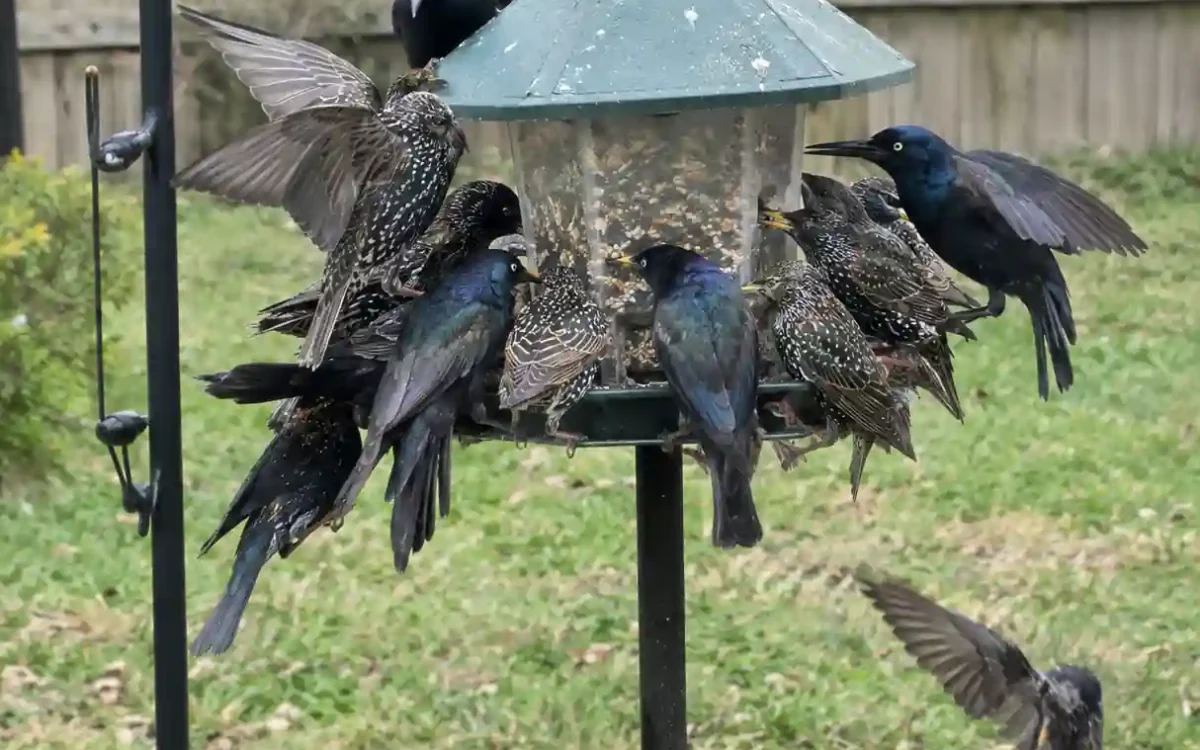
One minute the feeder is full of chickadees and finches; the next, a flock has stripped it bare, leaving scattered husks. The birds doing it are not villains. Starlings, grackles and pigeons are simply efficient — big, social, and fond of cheap seed — and that efficiency is the whole problem. The answer is not chasing them off, but making the setup less convenient for them, which shifts the balance back to the smaller birds.
Know the three birds doing the damage
The European starling is the most numerous of the three, and the newest arrival. The Cornell Lab of Ornithology notes that starlings were first brought to North America in the nineteenth century — introduced into New York’s Central Park in the late 1890s — and are now among the continent’s most numerous songbirds, with an estimated 200 million individuals. They are stocky black birds with short tails, triangular wings and long pointed bills, speckled white in winter and dark and glossy in summer, travelling in big, noisy flocks.
The common grackle is a native blackbird, larger and lankier, with long legs, a long tail and a flat head. Cornell measures it at 11.0–13.4 inches long and 2.6–5.0 ounces. The rock pigeon is the third regular: introduced to North America from Europe in the early 1600s, according to Cornell, and a ground feeder by habit, cleaning up whatever falls below the feeder.
| The feeder bullies, by the numbers | European starling | Common grackle |
|---|---|---|
| Scientific name | Sturnus vulgaris | Quiscalus quiscula |
| Length | 7.9–9.1 in | 11.0–13.4 in |
| Weight | 2.1–3.4 oz | 2.6–5.0 oz |
| Wingspan | 12.2–15.8 in | 14.2–18.1 in |
| North American population | About 200 million | About 67 million |
| Origin | Introduced, Central Park, late 1890s | Native |
Measurements: Cornell Lab of Ornithology, All About Birds. Population figures: starling, about 200 million (Cornell); grackle, about 67 million (Partners in Flight).

The seed switch is the fastest first step
Changing the seed is the cheapest fix, because blackbirds and starlings are picky in the opposite direction. Safflower seed has a bitter taste and a hard shell: cardinals, chickadees, titmice, finches and doves eat it happily, while grackles, starlings and most blackbirds try it once and leave. Birds & Blooms reports the same pattern from reader experience — safflower attracts cardinals and finches while starlings, which once ruled the feeder, stay away.
The second half of the switch is dropping the cheap filler mixes. Milo and cracked corn are magnets for blackbirds specifically, so a straight sunflower or safflower offering solves two problems with one change. Striped sunflower helps too: its thick shell needs a strong cracking bill, which cardinals and chickadees have and grackles do not use well. Offer one seed, not a mix — safflower mixed with other seed gets ignored while birds pick out the parts they like. The guide to the best bird seed for backyard birds breaks down which seed appeals to which species.
Cages and weight settings do the heavy lifting
Physically limiting access solves the problem at the source. A caged feeder surrounds the feeding ports with a wire cage wide enough for chickadees and finches to slip through, but too narrow for a grackle or starling to reach. One detail matters: the gap between the outer cage and the feeder itself. A cage set too close to the ports still lets larger birds stretch their necks and reach the seed, so a wider gap makes a noticeable difference.

Weight-activated feeders take a different approach: the feeding ports close automatically once something heavier than a songbird lands on the perch. A grackle at 2.6–5.0 ounces is far heavier than a chickadee, so the light setting on an adjustable feeder is the one to try. A low-hanging baffle above a feeder also discourages birds that dislike feeding under cover, though it works best paired with a cage or a seed switch. The same physical-barrier logic applies to squirrels — see the guide to keeping squirrels away from bird feeders.
Suet needs an upside-down answer
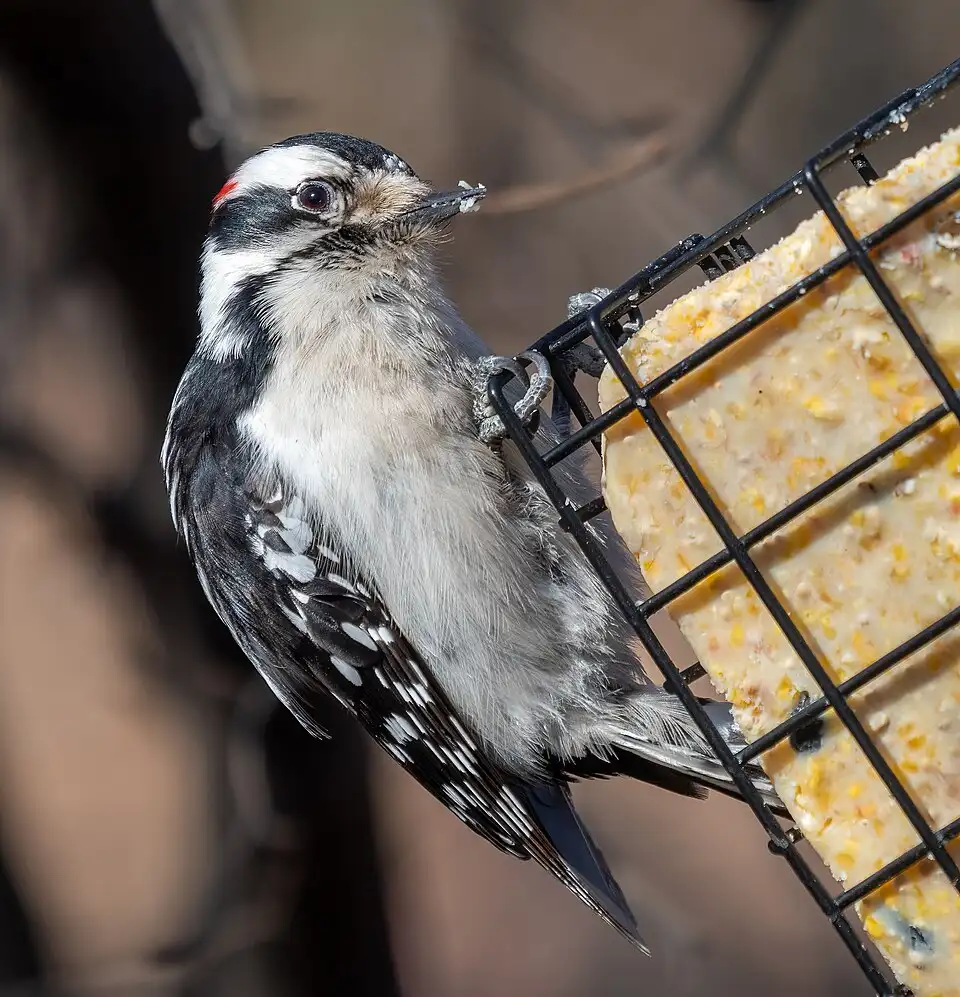
Starlings love suet, and a standard suet cage is an open invitation to the whole flock. The fix is a feeder that requires birds to hang upside down: the suet sits behind wire mesh on the underside, so birds must cling underneath and eat facing up. Woodpeckers, nuthatches and chickadees handle this easily; starlings find the posture difficult and usually move on. The University of Nebraska–Lincoln Extension puts it plainly: upside-down suet feeders, where the suet is only exposed from underneath, allow clinging birds to feed while excluding starlings, grackles and other unwanted birds.
Pigeons are a ground problem
Pigeons feed mostly from the ground rather than the feeder itself, so the fix is about spilled seed. Clean up underneath feeders regularly, and use a tube or hopper feeder on a pole with a catch tray, which limits how much seed ends up scattered below. Platform and tray feeders are the worst offenders for pigeon activity, because they offer easy open access; switching a ground-adjacent platform feeder to a raised tube or hopper style is often enough to cut pigeon visits significantly. Cornell adds a second reason to keep the ground clean: seed on the ground can attract rodents. The routine for that is covered in the guide to how to clean bird feeders.
The mistake: chasing them off by hand
The most common error is reaching for the quick fix: running out to shoo the flock, waving arms, banging on a window. It works for about a minute. Flocks return within the hour, and the small birds that were scared off too take longer to come back than the starlings do. The same applies to taking the feeder down permanently — it punishes the chickadees and finches far more than the flock, which simply moves to the next yard. Design beats deterrence: a seed switch plus one barrier, cage or baffle, works far faster than either alone, and needs no daily effort once set up.
Spring flocks pass — plan for the window
Grackles and starlings travel in mixed flocks and swarm feeders hardest in early spring, when natural food is still scarce but migration and nesting are already underway. These visits are often temporary: large mixed flocks pass through for a limited window rather than settling in permanently. Temporarily taking a feeder down for a week or two during a heavy flock passthrough is a legitimate, low-effort option, and the smaller birds generally return once it goes back up. The goal is not to eliminate the flock forever — it is to get through the heaviest weeks without losing the smaller visitors.
Quick answers
What is the best way to keep large birds off a bird feeder?
A caged or weight-activated feeder is usually the most reliable fix, since it physically blocks larger birds while still letting smaller songbirds feed normally. Pair it with a seed switch to safflower for faster results.
Does safflower seed really deter grackles and starlings?
For the most part, yes — most blackbirds and grackles find safflower unappealing, though it must be offered on its own rather than mixed with other seed to be fully effective.
Will a caged feeder stop pigeons too?
Usually yes, since pigeons are too large to fit through the cage openings, though they will likely still feed on any seed that spills to the ground below. Clean up spilled seed to finish the job.
Are starlings protected by law?
European starlings, house sparrows and feral pigeons are non-native introductions and are not protected under the federal Migratory Bird Treaty Act. But common grackles and other native blackbirds are protected — know which bird is at the feeder before acting, and use humane deterrents either way.
Redesign, don’t chase. Pick the combination that fits the yard — seed, cage, upside-down suet — and the small birds come back on their own. Plan the fix with the Feeding Tools planner, and see the complete guide to feeding backyard birds for how food, feeder types and placement work together.
Related guides: How to Keep Starlings Away From Bird Feeders (A Flock-Behaviour Guide) · How to Stop Birds Fighting at Your Feeder

Related Articles
How to Join Project FeederWatch: Count the Birds at Your Feeder This Winter
Project FeederWatch's 40th season runs 1 Nov 2026-30 Apr 2027. Join for $18, count birds at your feeder…
Read Article
How to Feed Birds While You’re on Vacation
Your birds won't starve while you're away — feeders are only about a quarter of their winter diet.…
Read Article
How to Stop Birds Fighting at Your Feeder
One feeder is one territory, so one bully bird can own it. Spread two or three different feeders…
Read Article