
Last updated: September 24, 2026 · 8 min read
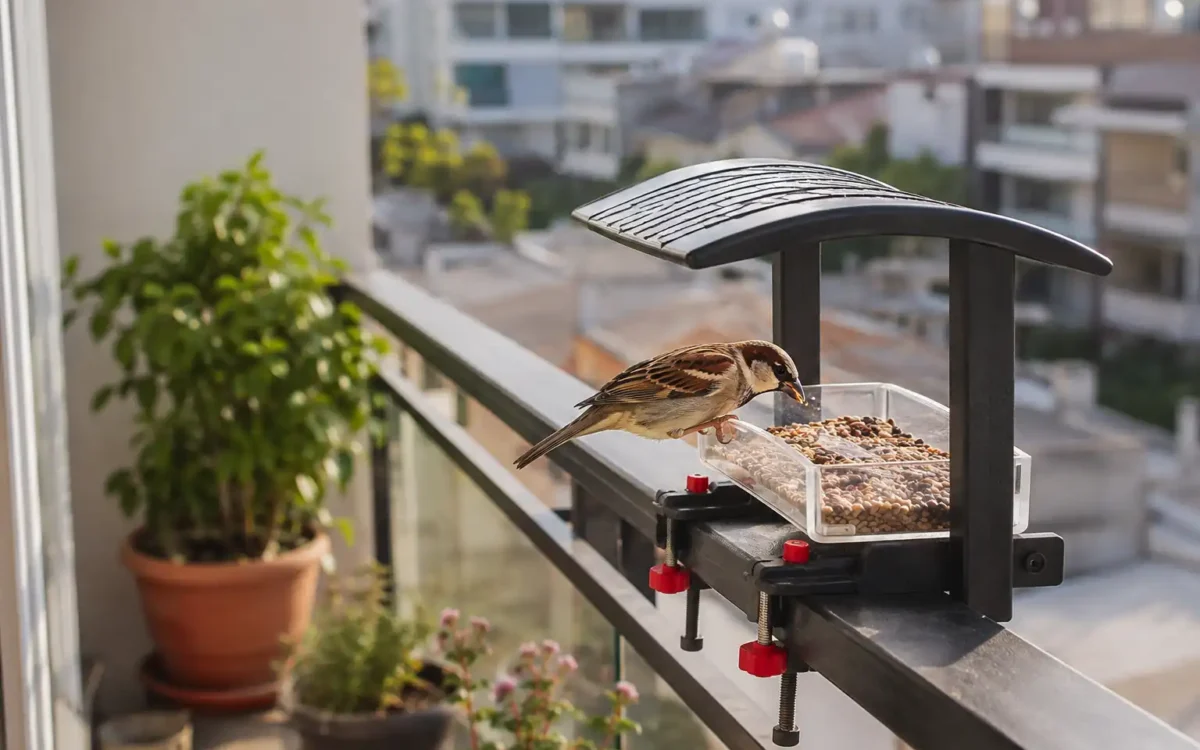
A side yard twelve feet wide changes the feeder equation. When you’re choosing the best bird feeders for small yards, every “best feeder” list seems written for people with acres — giant hopper stations, sprawling pole systems, feeding setups that would swallow an entire patio. The small-space way means choosing feeders by a different standard: compact footprint, low mess, maximum birds per square foot. These are seven designs that work when space is tight.
Disclosure: Bird Feedly is reader-supported. When you buy through links on our site, we may earn an affiliate commission at no extra cost to you. An honest note: these picks are based on widely-vetted feeder designs and community feedback, not lab-testing of every individual model — I recommend designs with strong track records, and I say so where it matters.
What Small Yards Actually Need
Forget “biggest capacity wins.” In a small space, the priorities flip:
- Compact footprint — mounts to a window, railing, or single slim pole
- Low mess — shells and hulls land on your patio, not the neighbor’s
- Easy to clean — you’ll service it often; fiddly designs get neglected
- Squirrel-manageable — tight quarters mean squirrels are always close; pick designs that work with baffles or weight-sensitive perches
- Multi-species appeal — one or two feeders must do the work of five
The 7 Best Bird Feeders for Small Yards (Comparison)
| # | Feeder type | Best for | Mess level | Price tier |
|---|---|---|---|---|
| 1 | Window feeder (suction-cup) | Closest views; apartments & balconies | Low | Budget |
| 2 | Small hopper feeder | Best all-rounder; cardinals, jays, finches | Medium | Budget–mid |
| 3 | Tube feeder (small perches) | Finches, chickadees; excludes large birds | Low–medium | Budget–mid |
| 4 | Suet cage with tail prop | Woodpeckers, nuthatches, wrens | Very low | Budget |
| 5 | Hummingbird feeder (saucer) | Hummingbirds; tiny footprint | Very low | Budget |
| 6 | Platform feeder with tray | Ground-feeding birds; doves, juncos | High (use tray) | Mid |
| 7 | Weight-sensitive “squirrel-proof” tube | Small yards near trees; squirrel wars | Low–medium | Mid–premium |
1. Window Feeder — the small-space champion
A clear acrylic box that suction-cups to your glass. Birds feed inches from your face — chickadees two feet away are a thrill for viewers of all ages. Zero yard footprint, and it sits in the window-safe zone by design. Downsides: small capacity (refill often) and suction cups need occasional re-wetting. Best seed: hulled sunflower hearts — no shells on your windowsill.
2. Small Hopper Feeder — the all-rounder
A compact hopper on a single pole or hanging bracket holds enough seed for days and welcomes the widest variety: cardinals, jays, finches, chickadees, titmice. Choose one with a removable tray or lift-off roof — cleaning a hopper you can’t open is miserable. Best seed: black-oil sunflower.
3. Tube Feeder With Small Perches — the finch specialist
Narrow tubes with short perches are goldfinch and chickadee magnets that naturally exclude jays, grackles, and doves (they can’t perch comfortably). Pick a model that fully disassembles — narrow tubes grow mold fast if you can’t scrub inside. Best seed: nyjer or black-oil sunflower.
4. Suet Cage With Tail Prop — the woodpecker invitation
The cheapest feeder here and one of the most rewarding. A wire cage holds a suet cake; the extended “tail prop” panel lets woodpeckers brace their stiff tail feathers, so they feed longer and return often. Near-zero mess. See our homemade suet recipes to fill it for pennies.
5. Saucer-Style Hummingbird Feeder — the tiny-footprint jewel
Saucer (dish) feeders beat inverted-bottle designs for small spaces: they don’t drip, they’re easy to clean, and bee guards fit the short ports. Hang one in dappled shade near flowers. Fill with our 1:4 nectar recipe — never the red store-bought mix.
6. Platform Feeder With Seed Tray — for ground birds
Doves, juncos, and sparrows won’t use tubes — they need a flat surface. A small platform feeder with a raised rim (or a tray under your hopper) serves them without broadcasting seed across the patio. It’s the messiest option, so pair it with hulled seed and a catch tray.
7. Weight-Sensitive Tube Feeder — for squirrel-adjacent yards
If your small yard sits under trees, squirrels will find your feeders. Weight-sensitive perches close the ports under a squirrel’s weight while staying open for birds. They cost more, but in squirrel-heavy spots they’re cheaper than replacing raided seed weekly. Complement — don’t replace — with proper squirrel-proofing placement.
The 6-Question Buyer Framework
Before buying any feeder, answer these:
- Where will it mount? (Window, railing, single pole, hanging bracket — measure first.)
- Which birds do I want? (Finches → tube; woodpeckers → suet; “everything” → hopper.)
- How messy can I tolerate? (Hulled hearts + trays for patios and balconies.)
- Are squirrels a factor? (Near trees → weight-sensitive or strict baffle setup.)
- Can I clean it easily? (If it doesn’t disassemble, skip it.)
- What’s my refill rhythm? (Small capacity = frequent refills; be honest about your schedule.)
Mess Management: The Small-Yard Survival Skill
In a big yard, hulls vanish into mulch. On a patio, they don’t. Three fixes:
- Switch to hulled sunflower hearts — no shells, every bite eaten. Costs more per pound, wastes nothing.
- Add catch trays under hopper and tube feeders.
- Rake or sweep weekly — a five-minute habit prevents the moldy mat that spreads disease.
Balcony & HOA Notes
Check your lease or HOA before mounting anything — some prohibit feeding outright (usually over pest concerns). Window feeders are the most “stealth” option. Keep volumes small, foods mess-free, and never let seed accumulate where it can attract rodents. A tidy feeding station has never gotten anyone evicted; a sloppy one has.
For the full setup walkthrough once you’ve chosen, see where to hang your feeder and pairing the right seed with each feeder.
Best Bird Feeders for Small Yards: FAQs
What is the best bird feeder for a small yard?
A window feeder or compact hopper feeder. Window feeders need zero yard space and give unbeatable close views; small hoppers attract the widest variety of birds. Add a suet cage for woodpeckers — it is cheap, tiny, and nearly mess-free.
How do I keep bird feeders from making a mess on my patio?
Use hulled sunflower hearts (no shells left behind), add catch trays under feeders, and sweep the area weekly. Avoid cheap mixed seed with filler — uneaten milo and wheat rot and create the worst mess.
Can I have a bird feeder on an apartment balcony?
Usually yes, but check your lease or HOA rules first. Window-mounted and railing feeders work best; stick to low-mess foods like hulled sunflower hearts and nyjer, and use a tray to catch debris so nothing rains onto neighbors below.
What feeder keeps squirrels out in a small yard?
Weight-sensitive tube feeders (ports close under a squirrel’s weight) work best where space is too tight for the 10-foot squirrel clearance rule. In slightly roomier small yards, a pole-mounted feeder with a baffle, placed as far from launch points as possible, also works.
How often should I clean a small feeder?
Every 1–2 weeks minimum — small feeders concentrate bird traffic on few perches, so disease spreads faster. Choose designs that fully disassemble; if you cannot scrub inside it, do not buy it. Our full routine is in easy-clean feeder care.
Keep Reading

Related Articles
How to Attract Dark-Eyed Juncos to Your Backyard: 7 Proven Tips (2026)
How to Attract Dark-Eyed Juncos to Your Backyard: 7 Proven Tips (2026) The first time I saw one,…
Read Article
How to Attract Goldfinches to Your Backyard: 7 Proven Tips (2026)
How to Attract Goldfinches to Your Backyard: 7 Proven Tips (2026) There is a moment every backyard bird…
Read Article
How to Attract Chickadees to Your Backyard: 7 Proven Tips (2026)
How to Attract Chickadees to Your Backyard: 7 Proven Tips (2026) If there is one bird that can…
Read Article