
Last updated: September 24, 2026 · 7 min read
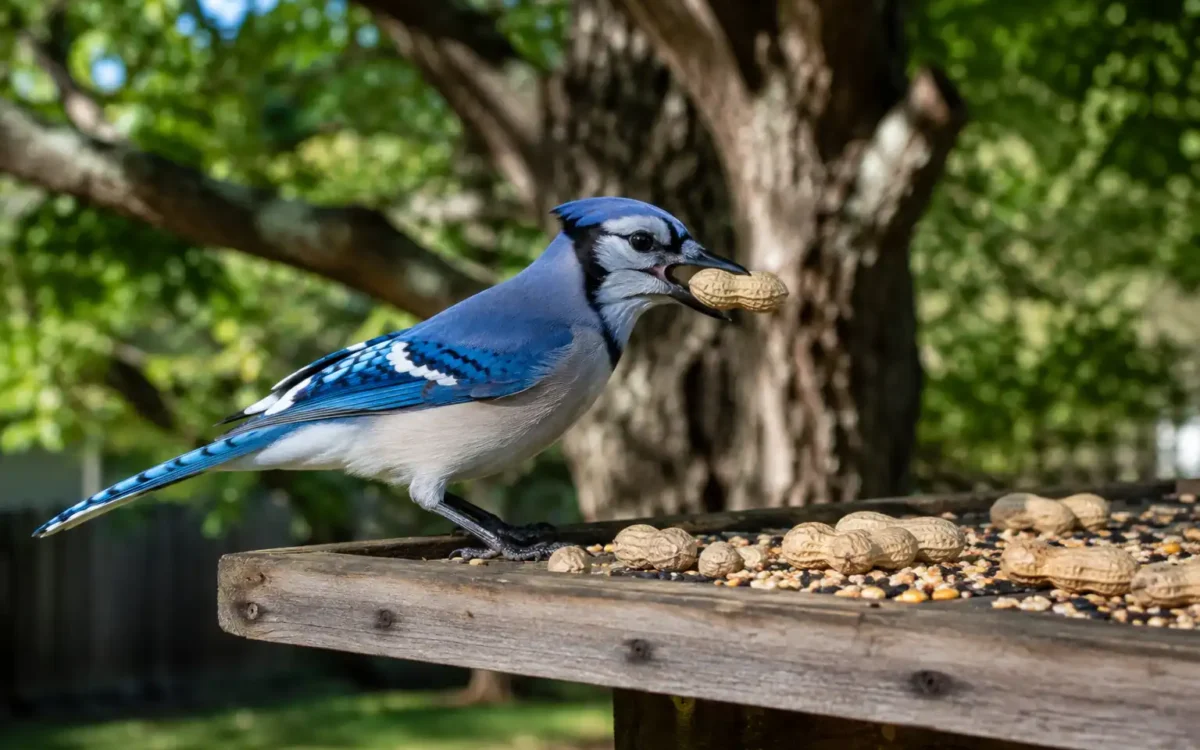
Blue jays are the drama queens of the backyard — loud, brilliant, and caching-obsessed. So what do blue jays eat? Feeding them isn’t about filling a tube feeder — it’s about understanding a smart, social bird and giving it the right stage, with the right foods.
Disclosure: Bird Feedly is reader-supported. When you buy through links on our site, we may earn an affiliate commission at no extra cost to you.
What Do Blue Jays Eat in the Wild?
Blue jays are omnivores with strong opinions. According to the Cornell Lab of Ornithology, roughly three-quarters of a blue jay’s natural diet is vegetable matter — acorns, beechnuts, and other mast are the headline act, especially in fall. The remaining quarter is animal prey: caterpillars, beetles, grasshoppers, and occasionally eggs or nestlings of other birds (their one PR problem, and it’s real but overblown).
The acorn relationship is the most fascinating part. A single jay can cache thousands of acorns in a season, carrying several at a time in its throat pouch and hammering them into the ground with remarkable spatial memory. Foresters quietly credit jays with planting oak forests. When you see a jay burying peanuts in mulch, it’s running ancient software — and it’s very good at it.
Favorite Feeder Foods, Ranked
Not all “bird food” excites a jay. Here are the top choices, in order of jay enthusiasm:
| Food | Jay rating | Best feeder | Notes |
|---|---|---|---|
| Peanuts in the shell | ★★★★★ | Platform or ground tray | The undisputed #1; watch them test-shell weight first |
| Striped sunflower seeds | ★★★★☆ | Platform or hopper | Bigger bill = handles big seeds easily |
| Suet (esp. peanut blend) | ★★★★☆ | Suet cage | Winter energy magnet |
| Cracked corn | ★★★☆☆ | Platform | Cheap; also attracts less-desired birds |
| Mealworms (dried) | ★★★☆☆ | Dish feeder | More of a spring protein hit |
| Black-oil sunflower | ★★★☆☆ | Any | Eaten, but they prefer striped |
The peanut ritual deserves a moment: jays will pick up several peanuts, shaking each one, apparently judging weight — researchers believe they’re selecting the heaviest (fullest) nuts. Whether it’s true discernment or theater, it’s endlessly entertaining.
How to Feed Jays (Without Feeding Every Bully in Town)
- Use a platform feeder with a roof. Jays are big birds that dislike clinging; trays suit them and exclude small-seed specialists.
- Offer peanuts in the shell, not shelled. The shell slows down smaller birds and gives jays the satisfying hammering work they clearly enjoy.
- Feed in the morning. Jays are early foragers. A modest morning handful often gets eaten by jays before the grackle committee convenes.
- Try a peanut wreath feeder. These wire wreaths hold in-shell peanuts and are genuinely jay-selective — small birds can’t work them, and squirrels find them awkward.
- Don’t overfill. A cup or two of peanuts is plenty. Endless supply trains every bird in the county to visit.
If bully birds are truly ruining the experience, see our guide to managing bully birds — safflower seed and caged feeders are your best friends there.
Foods to Avoid
- Bread, crackers, chips: junk calories, and they swell. Never a staple.
- Salted peanuts: salt is hard on birds’ kidneys. Raw, unsalted only.
- Flavored or seasoned nuts: garlic, chili, and coatings can be harmful.
- Moldy anything: peanuts mold easily — buy fresh, store dry (see our bird seed storage guide).
Three Jay Behaviors You’ll Love Watching
The hawk impression. Jays mimic red-shouldered hawk calls with eerie accuracy. The leading theory: they clear the feeder of competitors with a fake alarm, then eat in peace. Devious. Effective.
The mob. Jays are the neighborhood watch. Their harsh jeer-jeer calls rally other birds against hawks and owls. If your yard goes suddenly loud, look up — there’s usually a raptor.
The caching. Watch a jay in October and you’ll see the acorn economy in action: grab, fly, hammer into soil, repeat. They recover most caches, and the forgotten ones become oak trees.
Frequently Asked Questions
Do blue jays eat other birds’ eggs? Occasionally, yes — jays are opportunistic omnivores and will take eggs or nestlings when the chance arises. But Cornell’s diet data shows this is a small fraction of their intake; insects, nuts, and seeds dominate. It’s natural behavior, not a reason to chase jays away.
Will blue jays scare away smaller birds? They can dominate a feeder by size and attitude, though they’re less aggressive than grackles or starlings. Offering a separate tube feeder with small seeds gives finches and chickadees their own space while jays work the platform.
Are peanuts in the shell safe for blue jays? Yes — raw, unsalted peanuts in the shell are one of the best foods you can offer jays. Buy human-grade peanuts, keep them dry, and discard any that smell musty. Never offer salted, flavored, or candy-coated nuts.
How do I attract blue jays if I’ve never seen one? Start with a platform feeder and in-shell peanuts, placed near cover (they like staging in trees). Jays are social and noisy — once one finds your peanuts, its family usually follows within days. Fall is the easiest season to attract them.
Do blue jays migrate? Some do, some don’t — it’s one of the mysteries of the species. In any given year, a portion of the population migrates while others stay put, and scientists still debate what drives the decision. Keep feeders going either way; winter jays are loyal customers.
Blue jays are the drama, comedy, and neighborhood watch of the backyard all at once. Give them peanuts, give them space, and enjoy the show. For the full foundation — feeder types, seed selection, and year-round schedules — start with our beginner’s feeding guide.
Keep Reading

Related Articles
How to Attract Dark-Eyed Juncos to Your Backyard: 7 Proven Tips (2026)
How to Attract Dark-Eyed Juncos to Your Backyard: 7 Proven Tips (2026) The first time I saw one,…
Read Article
How to Attract Goldfinches to Your Backyard: 7 Proven Tips (2026)
How to Attract Goldfinches to Your Backyard: 7 Proven Tips (2026) There is a moment every backyard bird…
Read Article
How to Attract Chickadees to Your Backyard: 7 Proven Tips (2026)
How to Attract Chickadees to Your Backyard: 7 Proven Tips (2026) If there is one bird that can…
Read Article