The short version
The Christmas Bird Count runs 14 December 2026 to 5 January 2027, and you can join it without leaving your house. If your home sits inside one of Audubon’s 15-mile count circles, sign up as a feeder watcher: find your circle on Audubon’s Circle Finder, email the compiler, and count the birds at your feeder on your circle’s count day. Free, no experience needed — and your numbers join the same dataset as the field teams’.
Your window is a territory
Every December, the National Audubon Society’s Christmas Bird Count sends volunteers out to count every bird inside more than 2,700 circles across the Americas. The 2026–27 season is the 127th count: in 2025, over 85,000 people counted more than 44 million birds. But not every counter walks. If your home sits inside a circle, your feeder is a territory of its own — feeder watchers count the birds that visit their yards on count day, and their numbers go into the same dataset.
Circles genuinely need them: without feeder watchers, the birds that live around houses — juncos, House Finches, sparrows — come back suspiciously low. Your window covers ground nobody else can.
Before count day: three moves
- Find your circle. Open Audubon’s Circle Finder and check whether your home falls inside a circle’s boundary. Circles shown green or yellow are open to new participants; red ones are full — in that case, try the next circle out.
- Email the compiler. Every circle has a volunteer compiler, and their email is on the circle’s pop-up. Write weeks ahead: say where you live, that you would like to be a feeder watcher, and that you are new. No test, no membership, no fee — beginners are paired with experienced counters.
- Set the table. Clean the feeders first — our cleaning guide covers the weekly winter routine — then fill them with high-fat winter food and keep liquid water open. The full setup is in our winter bird feeding guide.
Count day: how the counting works
Your circle counts on one day between 14 December and 5 January, picked by the compiler. Watch as long as you like — a couple of hours is typical, and even 15 focused minutes counts. Four rules keep your numbers honest:
Count only count-day birds in your yard. A bird across the street outside the circle does not belong on your list. Include yard birds even if they never touch a feeder.
Record the most seen at one time, not every visit. Three chickadees at once, then two later, is still three — not five. If four appear together later, your number becomes four. This stops the same bird being counted five times.
Record your effort. Note the total time you spent watching. Effort is data too: it lets scientists compare this year fairly with last year, instead of mistaking “we looked harder” for a real population change.
Keep a camera handy. A rare or unexpected bird needs a photo — your compiler will ask for one. Write sightings down or enter them in eBird — your compiler will say which they want.
What the compiler needs from you: your species list with the highest number seen at one time for each, the total hours you watched, and the date. Send it the same day — most circles tally that evening.
Who will show up at your feeder
The usual December crowd: Black-capped chickadees, Dark-eyed Juncos hopping below the feeders, Northern Cardinals in pairs, American Goldfinches on the nyjer, and Downy Woodpeckers on the suet. This winter carries extra interest: the Winter Finch Forecast expects Pine Siskins moving into the Northeast and Great Lakes — the same movement our Project FeederWatch guide is tracking.
Three mistakes that waste a count
Adding up every visit. The classic error — see the max-at-once rule above. Feeder counts are built on it.
Counting beyond your yard. Your count site is your yard, inside your circle.
Forgetting the effort. Hours watched matter as much as birds seen.
Feeder watcher vs field counter
| Feeder watcher | Field counter | |
|---|---|---|
| Where you count | Your yard, at home | An assigned territory, on foot |
| Time on the day | A couple of hours; even 15 minutes counts | All day, often from before dawn |
| Walking | None | Miles, in December weather |
| ID skill needed | Beginner-friendly — count what you know | Any level; beginners paired with experts |
| What you record | Most at once per species, plus hours watched | Every bird seen or heard, plus miles and hours |
| Cost | Free | Free |
Count-day checklist
- Circle found, compiler emailed, count day on the calendar
- Feeders clean and full — sunflower seed, suet, nyjer
- Water open — heater running, or morning refills ready
- Tally sheet or eBird open, pen that works in the cold
- Binoculars by the window, ID guide or Merlin app ready
- Camera charged, for anything unusual
After count day: your numbers join the record
The count began on Christmas Day 1900, when ornithologist Frank M. Chapman and 27 volunteers ran 25 counts and tallied 90 species — a census to replace a hunting contest. Today the data feeds more than 300 peer-reviewed studies, tracking range shifts and recoveries no shorter dataset can see. Your one day at the window becomes part of a 127-year record.
Frequently asked questions
Do I need to leave my house to join the Christmas Bird Count?
No. If your home is inside a count circle, you can count the birds at your feeder as a feeder watcher — with prior arrangement with the circle’s compiler.
How do I find my local count circle and compiler?
Use Audubon’s Circle Finder at cbc.audubon.org. Green and yellow circles are open to new participants and red ones are full; each circle’s pop-up carries the compiler’s email.
What does a feeder watcher actually count?
Every bird seen in your yard on count day. For each species, record the highest number seen at one time — not every visit added up — plus the total time you spent watching.
How much does it cost to join?
Nothing. Participation in the Christmas Bird Count is free.
When is the 2026–27 Christmas Bird Count?
Each circle counts on one day between 14 December 2026 and 5 January 2027, chosen by its compiler. The 2026–27 season is the 127th count.
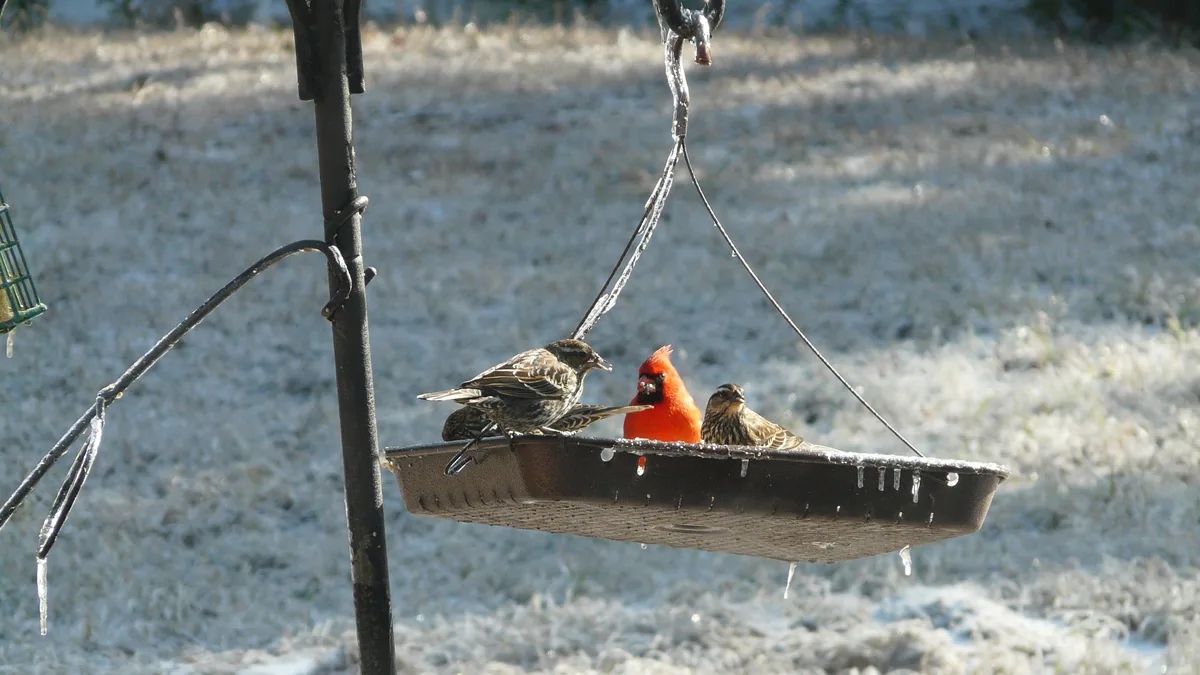
Featured photo: Female red-winged blackbirds and a male northern cardinal at an icy feeder, 22 January 2025, The Bushranger, CC BY-SA 4.0, via Wikimedia Commons.

Related Articles
Pine Siskin Irruption 2026–27: Essential Feeder Prep
A sizable Pine Siskin irruption is forecast for winter 2026–27 and flocks are already moving. Fresh nyjer, sunflower…
Read Article
What Visits a Backyard Feeder in Early November
Short Answer: Early November is when the winter feeder crowd settles in. Cardinals, chickadees, goldfinches and blue jays…
Read Article
How to Attract Orioles to Your Backyard (Complete Guide)
Short Answer Set a dedicated bright-orange feeder out 1–2 weeks before orioles arrive in late April to mid-May,…
Read Article