
Last updated: September 24, 2026 · 7 min read
Learning where to place bird feeders is half the hobby. A first feeder often goes on a lone pole in the middle of the lawn — maximum visibility, or so it seems, for viewer and birds. The birds often disagree. For a month, almost nothing visits. The day that same feeder is moved ten feet from a lilac bush, chickadees find it within 48 hours. Placement isn’t a minor detail.
Disclosure: Bird Feedly is reader-supported. When you buy through links on our site, we may earn an affiliate commission at no extra cost to you.
Where to Place Bird Feeders: Think Like a Bird
Birds evaluate a feeding spot with one question: can I eat here without being eaten? Every placement rule below flows from that instinct. Your job is to offer food within a quick dash of escape cover, visible enough to be found, and positioned so predators — hawks from above, cats from below — can’t easily ambush.
Rule 1: Near Cover, Not in the Open
Place feeders 10–12 feet from shrubs, trees, or a brush pile — close enough that a feeding bird can dive for cover in a second, far enough that a lurking cat can’t use the same shrub as an ambush blind. A dead-center lawn pole fails this rule completely; birds can see the seed but won’t risk the exposed approach.
Dense evergreens are the gold standard (winter cover + hawk protection), but any thick shrubbery works. No shrubs at all? A brush pile of stacked branches creates instant cover while your plantings grow in.
Rule 2: Get the Height Right
Hang or mount feeders about 5 feet off the ground. This is the sweet spot: high enough to deter ground predators and make cats work for it, low enough for easy refilling and cleaning. (If cleaning is a hassle, you’ll do it less — and dirty feeders harm birds. Design for your own laziness.)
Ground-feeding birds — doves, juncos, sparrows — prefer platform feeders or scattered seed at ground level, ideally under cover rather than in the open.
Rule 3: Respect the Window Strike Zones
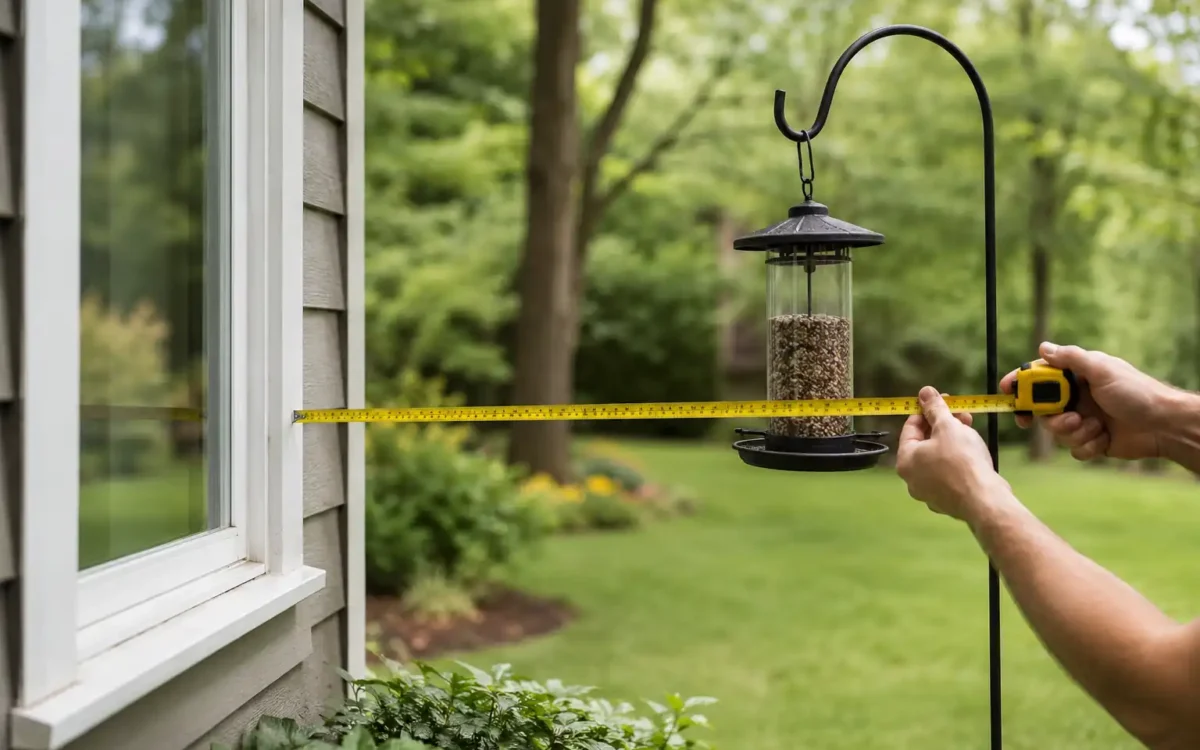
This one saves lives. Birds collide with windows when they see sky or greenery reflected and try to fly through. The research-backed guidance:
- Within 3 feet of a window: safe. Birds can’t build up lethal speed in such a short flight, and they usually flutter off unharmed.
- More than 30 feet from windows: safe. They read the house as a solid obstacle and steer around it.
- Between 3 and 30 feet: the danger zone. This is where most fatal strikes happen.
If your best viewing spot falls in the danger zone, either move the feeder or apply window decals/tape patterns to break up reflections. Moving the feeder is simpler and more reliable than any sticker.
Rule 4: Use the 10-Foot Squirrel Rule
Squirrels can jump 8–10 feet horizontally (up to 10–12 with a running start) and 4–5 feet vertically. So pole-mounted feeders need a clear zone: at least 10 feet from any “launch pad” — trees, fences, deck rails, sheds, wires. Add a baffle on the pole 4+ feet off the ground, and squirrels are defeated by physics, not cleverness.
Hanging feeders need the same thinking: hang from a branch at least 10 feet from the trunk, with a dome baffle above. Full tactics are in our squirrel-proofing guide.
Rule 5: Mind Sun, Wind, and Drainage
- Sun: Morning sun with afternoon shade is ideal. All-day blazing sun spoils seed and nectar faster and fades plastic feeders.
- Wind: Position feeders out of prevailing winter wind — against a fence or hedge, not on the exposed side of the yard. Birds feed far more in sheltered spots during cold snaps (see our winter placement adjustments).
- Drainage: Avoid low spots where water pools under the feeder. Wet ground under a feeder becomes a moldy, disease-harboring mat of hulls. Slightly elevated, well-drained ground is best.
Rule 6: Keep It Where You’ll See It (and Maintain It)
The “best” placement you never look at is worthless. Birds are endlessly entertaining, and watching them is the point — put feeders where you’ll actually see them from your favorite window or patio chair. Just keep that window at a safe distance (Rule 3). A feeder you enjoy watching is a feeder you’ll keep filled and cleaned.
Balcony and Apartment Placement
No yard? You can still feed birds:
- Railing-mounted or window feeders bring birds inches from your glass — thrilling, and window feeders sit in the safe <3 ft zone by design.
- Check your lease/HOA first. Some buildings prohibit feeding (pest concerns); a quick ask beats a fine.
- Go mess-free: hulled sunflower hearts and nyjer leave no shells to rain down on neighbors — see choosing the right feeder for your space.
- Mind the drop zone. A small tray or mat under the feeder keeps your balcony (and the neighbor’s) clean.
5 Placement Mistakes to Avoid
- Dead-center open lawn — maximum exposure, minimum bird confidence.
- Right against dense shrubs — cover becomes a cat’s ambush blind; keep that 10–12 ft gap.
- In the window-strike zone (3–30 ft from glass) without decals.
- Within squirrel-jumping range of trees, fences, or rails.
- Where you’ll never see or service it — out of sight becomes out of mind, then moldy.
If your feeder is being ignored, placement is suspect #1 — run through our troubleshooting checklist before buying anything new.
Quick-Reference Placement Card
| Factor | The rule |
|---|---|
| Distance from cover | 10–12 ft from shrubs/trees |
| Feeder height | ~5 ft off the ground |
| Window distance | <3 ft OR >30 ft (never 3–30 ft) |
| Squirrel clearance | 10+ ft from launch pads; baffle 4+ ft up pole |
| Sun | Morning sun, afternoon shade |
| Wind | Sheltered from prevailing winter wind |
| Ground | Well-drained, not a puddle zone |
Get these seven right and you’ve solved most “why won’t birds come?” mysteries before they start. For everything after placement — food, feeders, cleaning — see our complete beginner’s guide.
Where to Place Bird Feeders: FAQs
Where is the best place to hang a bird feeder?
About 10–12 feet from shrubs or trees (escape cover), 5 feet off the ground, in morning sun with afternoon shade, either within 3 feet of your window or more than 30 feet away, and at least 10 feet from anything a squirrel could launch from.
How far should a bird feeder be from a window?
Either closer than 3 feet or farther than 30 feet. Between 3 and 30 feet is the window-strike danger zone, where birds build up enough speed for fatal collisions. If your feeder must sit in that zone, apply window decals to break up reflections.
How high off the ground should a bird feeder be?
Around 5 feet. That is high enough to discourage cats and ground predators while staying easy for you to refill and clean. Squirrels can jump 4–5 feet vertically, so pair the height with a pole baffle for real protection.
Can I put a bird feeder on my apartment balcony?
Yes — window feeders and railing-mounted feeders work beautifully. Check your lease or HOA rules first, use mess-free foods like hulled sunflower hearts to avoid shelling raining on neighbors, and place a tray underneath to catch debris.
Why won’t birds come to my new feeder location?
The most common reasons: too exposed (no nearby cover), in the window-strike zone, within squirrel range, or simply too new — birds can take 2–4 weeks to trust a new spot. Keep it consistently filled during the discovery period and run our troubleshooting guide.
Keep Reading

Related Articles
How to Attract Dark-Eyed Juncos to Your Backyard: 7 Proven Tips (2026)
How to Attract Dark-Eyed Juncos to Your Backyard: 7 Proven Tips (2026) The first time I saw one,…
Read Article
How to Attract Goldfinches to Your Backyard: 7 Proven Tips (2026)
How to Attract Goldfinches to Your Backyard: 7 Proven Tips (2026) There is a moment every backyard bird…
Read Article
How to Attract Chickadees to Your Backyard: 7 Proven Tips (2026)
How to Attract Chickadees to Your Backyard: 7 Proven Tips (2026) If there is one bird that can…
Read Article