
A few years ago I found a small warbler lying stunned on the patio one morning, right below a large picture window that reflected the trees behind it almost perfectly. It survived and eventually flew off on its own, but that single quiet moment changed how I looked at every window in the house afterward. Learning how to prevent birds from hitting windows turned out to be less about luck and more about a handful of specific, well-tested fixes.
Window strikes are far more common than most homeowners realize, and the fixes are usually inexpensive and quick to put in place once you know what actually works — and what doesn’t.
Some of the most repeated advice out there, like hawk stickers placed dead center on a window, turns out to do almost nothing. What actually helps is simpler, cheaper, and a little less obvious.
Why Do Birds Fly Into Windows
Why do birds fly into windows comes down to one simple fact: birds don’t see glass the way we do. Either the glass reflects trees and sky so convincingly that it looks like open space to fly through, or it’s transparent enough that a bird sees a plant or open area on the other side and tries to fly straight to it.
Why do birds attack their reflection in windows is a slightly different issue, often called reflection aggression. According to Cornell Lab’s All About Birds, this mostly happens during spring when territorial behavior is high, and while it can look alarming, it’s rarely dangerous to the bird compared to a genuine collision.
Both problems share the same underlying cause: the bird simply isn’t registering the glass as a solid surface at all, whether it’s seeing sky, trees, or its own reflection staring back at it.
Identifying Your Most Dangerous Windows
Not every window carries equal risk. Large picture windows, windows paired at right angles to each other, and any window with a bird feeder positioned outside it tend to cause the most strikes. Walking around your house and looking at each window from the outside, at different times of day, quickly reveals which ones reflect the most sky or vegetation.
How to stop birds from hitting windows at night is worth mentioning here too — interior lighting left on after dark can disorient migrating birds, especially during spring and fall migration, so turning off nonessential lights during those seasons genuinely helps beyond daytime fixes.
If you have a record of collisions happening in the same general area of your house, that pattern is worth trusting more than guesswork. Treat the worst offenders first rather than trying to fix every window in one weekend.
Bird Safe Window Decals
Bird safe window decals are one of the most popular fixes, but they only work if applied correctly. Do hawk decals actually stop birds from hitting windows? Not on their own — a single sticker in the middle of a large window does almost nothing, regardless of its shape or design.
How to make a DIY bird deterrent for windows is often cheaper and just as effective: a bar of soap drawn directly onto the outside of the glass, or a homemade cord curtain like the well-documented Acopian BirdSavers design, both rely on the same principle as commercial decals — breaking up the reflection across the entire surface, not just one spot.
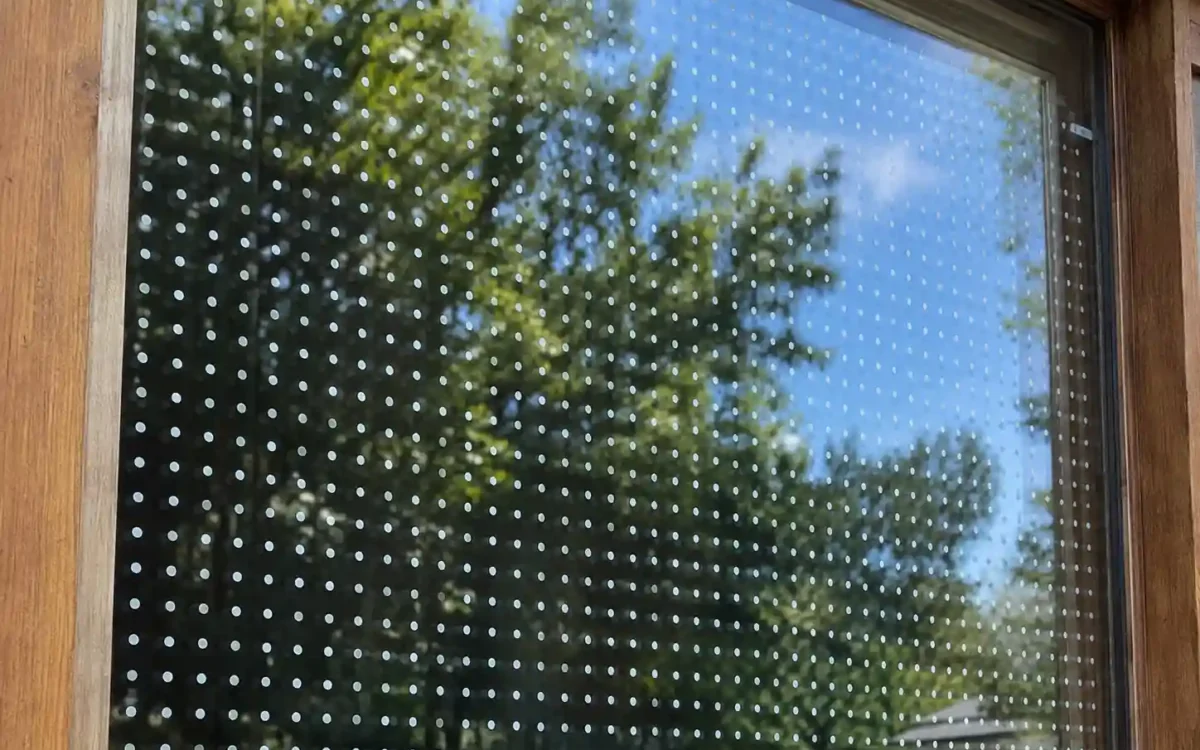
The shape of the marker genuinely doesn’t matter much, despite what a lot of product packaging implies. A grid of simple dots is just as effective as an elaborate bird or hawk silhouette, as long as the spacing rule below is followed.
The 2×2 Rule for Window Strikes
The 2×2 rule for window strikes is the single most important detail in this whole topic, and it’s the one most people get wrong. Markers, whether decals, tape, or paint, need to be spaced no more than two inches apart in every direction across the entire window.
Best spacing for window decals to prevent bird strikes follows this same rule — a handful of decals scattered loosely across a window leaves gaps a bird can still fly through, so full coverage matters more than the number of individual markers used.
It helps to think of it less as decoration and more as a grid. Measuring out the two-inch spacing with painter’s tape first, before applying anything permanent, makes it much easier to get even coverage on a large window.
Window Film for Bird Strikes
Window film for bird strikes offers a more permanent, less visually intrusive option than individual decals. Best bird-safe window film options generally use a perforated or dot-matrix pattern that’s visible to birds from the outside but barely noticeable from inside, preserving your view while still breaking up the reflection.
Do window screens prevent bird collisions is a fair question too — a standard exterior window screen does soften the impact somewhat and can genuinely help in lower-risk situations, though it’s not a full substitute for proper decal or film coverage on your highest-risk windows.
Film tends to be the better long-term investment for windows that see repeated strikes, since it doesn’t need reapplying the way soap markings do and holds up through weather far better than tape.
A friend of mine dealt with repeated strikes on a sunroom window for most of a season before mentioning it to me. What finally worked wasn’t anything expensive — it was switching from three or four scattered decals to a full grid of dot markers spaced two inches apart across the entire pane. The strikes stopped almost immediately once the whole window was actually covered, rather than just a corner of it.
What stuck with me was how simple the actual fix turned out to be, once the real problem — incomplete coverage — was identified. It wasn’t about buying a better product at all.
Best Distance for a Bird Feeder From Windows
Best distance for a bird feeder from windows might be the single most counterintuitive tip in this entire guide. Is a closer or farther feeder distance safer from windows? Counterintuitively, very close is often safer than a middle distance — a feeder within about three feet of a window means birds simply can’t gain enough speed to injure themselves badly on impact, while a feeder more than thirty feet away keeps them far enough that they’re unlikely to be startled toward the glass in the first place.
It’s the distances in between — roughly five to twenty feet — that tend to cause the most serious strikes, since birds have enough room to build real speed but not enough distance to register the glass as a barrier ahead of them. This is a detail we also touch on in our guide to where to place a bird feeder in your backyard.
| Stage | What to Do |
|---|---|
| Stage 1 | Identify your highest-risk windows by checking reflections at different times of day |
| Stage 2 | Apply a quick, low-cost fix like soap markings or spaced-out decals following the 2×2 rule |
| Stage 3 | Upgrade to window film or a cord curtain for a more permanent, less visible solution |
| Stage 4 | Adjust feeder placement and reduce nighttime lighting during migration season |
What to Do If a Bird Hits Your Window
Knowing what to do if a bird hits your window matters just as much as prevention. How to tell if a bird is stunned or dead after hitting a window comes down to watching closely for a few minutes — a stunned bird will often be still but breathing, sometimes blinking, while a bird that shows no movement or breathing after several minutes has likely not survived.
How to help a stunned bird recover safely is straightforward: gently place it in a covered, ventilated box lined with a soft cloth, keep it somewhere quiet and dark, and leave it undisturbed for twenty to thirty minutes. Most stunned birds recover fully and fly off on their own once given that quiet recovery window, without needing any further intervention.
Keep pets away from the box entirely during this time, and resist the urge to check on the bird repeatedly, since the stress of handling can do more harm than the original impact in some cases.
Putting Window Safety Into Your Whole Setup
Window strikes are one part of a bigger picture that includes food, water, and safe placement working together. If you’re building out your feeding station with all of this in mind, our complete guide to feeding backyard birds ties these decisions together in one place, and our piece on fall bird migration covers why this particular season sees the highest number of window strikes nationwide.
Frequently Asked Questions
Why do birds fly into windows?
Mostly because they don’t perceive glass as a barrier — reflections of sky and trees, or a clear view through to the other side, both make windows look like open space.
What is the 2×2 inch rule for window decals?
It means markers on a window need to be spaced no more than two inches apart in every direction to reliably prevent birds from attempting to fly through the gaps.
What should I do if a bird hits my window?
If it’s stunned but breathing, place it gently in a ventilated, covered box somewhere quiet and dark for twenty to thirty minutes before checking on it again.
Do hawk silhouette stickers actually work?
Not reliably on their own. A single sticker anywhere on a window has little effect; full, evenly spaced coverage is what actually prevents strikes.
How far should a bird feeder be from a window?
Either within about three feet or more than thirty feet is safest — distances in between tend to cause the most serious collisions.
Can curtains or blinds prevent bird window strikes?
Sometimes, but only if the issue is birds trying to reach a visible space behind the glass. If the problem is reflection instead, curtains alone won’t solve it.
How to Prevent Birds From Hitting Windows: Which of Your Windows Would Fail This Test?
Take a walk around the outside of your house this week and look at each window from a bird’s height — does any of them reflect the sky or trees so clearly that you’d second-guess whether it was even glass?

Related Articles
How to Keep Starlings Away From Bird Feeders: 7 Proven Tips (2026)
Nothing empties a bird feeder faster than a flock of European starlings. One minute your tube feeder is…
Read Article
How to Keep Deer Away From Bird Feeders: 7 Proven Ways (2026)
One October morning, coffee in hand, you walk to the back window expecting the usual rush of chickadees…
Read Article
When to Take Down Hummingbird Feeders: 7 Smart Rules (2026)
Every September, I find myself standing at the kitchen window, coffee in hand, staring at my hummingbird feeder…
Read Article