The Morning After the Snow
On 21 November 2026, USA Today reported that finding food after heavy snowfall is especially challenging for birds, quoting the Cornell Lab. Snow buries the seeds and berries that ground-feeding birds live on, and a deep cover leaves them nothing. Audubon notes that a bad snow or ice storm that buries natural food is the exception, when feeder seed can be lifesaving. A 2006 report from the U.S. Fish and Wildlife Service estimated that about 55.5 million Americans provided food for wild birds.
Who Comes Down to the Ground
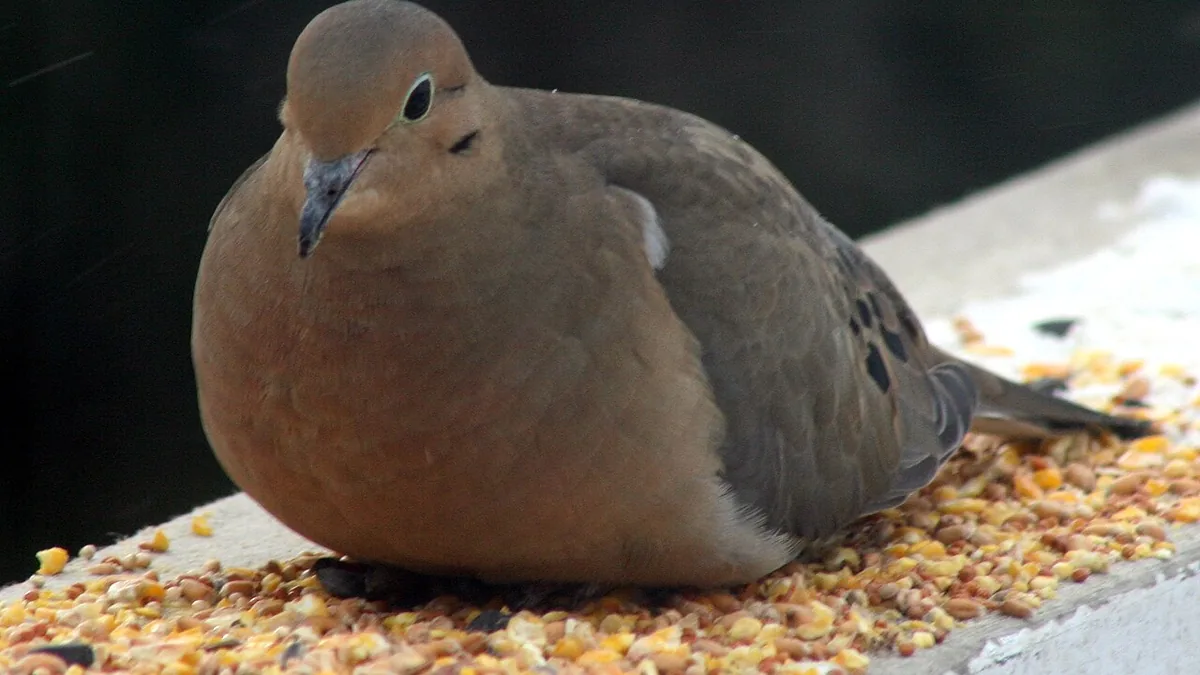
The dark-eyed junco appears at 97 percent of FeederWatch sites, more than any other feeder bird. Mourning doves appear at 94 percent of sites, and northern cardinals at 91 percent. White-throated sparrows and song sparrows join them, and sunflower seeds will feed all five. The junco guide will help you tell a junco from a sparrow, and the food guide will show you the seeds they prefer.
Where the Snow Hides the Food
A lawn under deep snow holds nothing a junco can reach, and the weed seeds that fed sparrows in autumn lie buried under the crust. Berries will hang out of reach above the snow, and the insects will stay hidden until spring, so the ground feeders will turn to you. You will look for the bare spots first: the ground under evergreens stays clearer, because the branches hold the snow above it.
The Scatter Map
You will clear a patch down to the grass and scatter millet and cracked corn there. You will scatter a second handful under the evergreens, where the snow stays thin. You will set a low tray with a screen bottom near cover and fill it with sunflower chips. You will press the snow flat below the hanging feeders, so seed will sit on a firm surface instead of sinking. The winter menu lists the seeds for cold weather, and black-oil sunflower stands first. You will scatter only what the birds will eat in a day.
Bird, Food, and Place
The table will match each bird to its food and its place.
| Bird | What they will eat | Where you will put it |
|---|---|---|
| Dark-eyed junco | They will eat millet and sunflower seeds | You will scatter it on the cleared patch |
| Mourning dove | They will eat cracked corn, millet, and sunflower seeds | You will scatter it on the ground |
| White-throated sparrow | They will eat sunflower seeds and millet | You will scatter it under cover at the patch edge |
| Song sparrow | They will eat sunflower seeds and millet | You will scatter it on the cleared patch |
| Northern cardinal | They will eat sunflower seeds and seed mixes | You will offer it on the ground or a platform |
The November roundup lists the birds at feeders in late autumn. The cardinal guide shows how to keep cardinals coming to the same tray all winter. The robin guide shows what robins eat when the ground freezes.
What Does Not Work on White Ground
You will not scatter bread: it fills a bird without the fat it needs for a cold night. You will not scatter seed on deep snow: it will sink out of sight before a bird finds it. Uneaten seed will foster mold, and a stale pile left for days will do more harm than good. You will not put seed on ice, because it will melt and refreeze into a sheet no bird can peck apart.
Keeping the Ground Patch Clean
Penn State Extension asks you to rotate the ground feeding area and rake up droppings and old seed. You will move the scatter patch a few feet every week. You will scrub platform feeders once a week and let them dry. The winter storm guide will help you through the worst nights.
A Short History of Winter Counting
The Christmas Bird Count began in 1900, when 27 observers counted birds at 25 locations instead of hunting them. In 1976, Erica Dunn established the Ontario Bird Feeder Survey at the Long Point Bird Observatory in Canada. In the winter of 1987-88, more than 4,000 people enrolled in Project FeederWatch, the survey that grew from her work with Cornell. The first Great Backyard Bird Count was held in 1998, and bird watchers submitted about 13,500 checklists. In 2002, the National Science Foundation funded eBird, the platform the count uses today. The Christmas Bird Count runs December 14 to January 5, and the Great Backyard Bird Count runs February 12 to 15, 2027. Your scatter patch will join that history, and the birds you feed will be the birds the counts track.
Your First Snow-Morning Scatter
- You will step out after the snowfall and pick the patch nearest cover.
- You will clear the snow to the grass or press it flat.
- You will scatter millet and cracked corn on the cleared patch.
- You will scatter a second handful under the evergreens.
- You will fill the low tray with sunflower chips and millet.
- You will rake up old seed and droppings first.
Questions You Will Ask
Will ground-feeding birds come to my feeders in the snow?
They will: Penn State notes that ground feeders grow much less common at feeders without snow cover, so snow brings them in.
What food will I scatter on the snow?
You will scatter millet, cracked corn, and sunflower chips on a cleared patch or a low tray. Black-oil sunflower will attract the most species, and Penn State calls it the best all-round seed.
Will bread feed birds in the snow?
It will fill them without the fat they need, so skip it and scatter millet, cracked corn, and sunflower chips instead.
How often will I clean the scatter patch?
You will rake up old seed and droppings every week and move the patch as the ground dirties. Penn State asks you to rotate the feeding area.
Will the birds find food I scatter before dawn?
They will find a fresh scatter waiting, because birds feed early on winter mornings.

Related Articles
How to Clean Bird Feeders When It Is Freezing Outside
Bring the feeder indoors to thaw, wash it inside with warm water, and dry it fully. The freeze…
Read Article
Why Birds Will Eat Far More Before a Cold Snap
Birds feed hardest in the day before a cold snap. Read the surge, watch the falling barometer, and…
Read Article
The Birds That Will Visit Your Feeder in Late November
Late November will bring a new cast to your feeder. The dark-eyed juncos will arrive from the north,…
Read Article