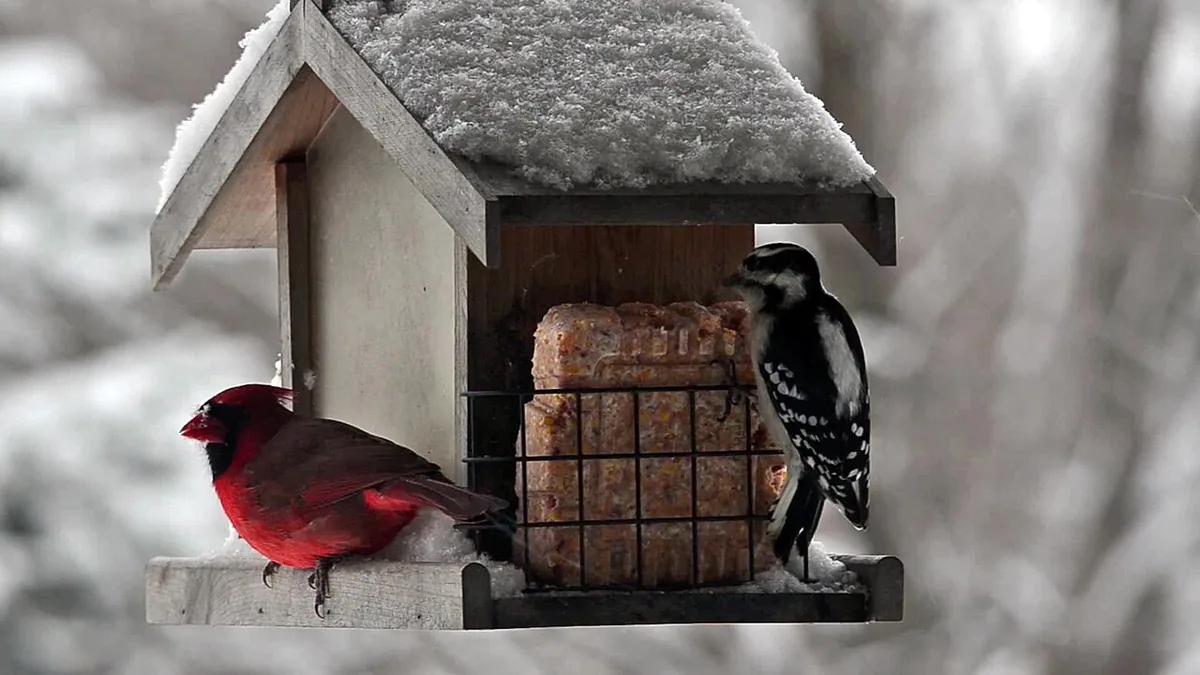
The Morning the Feeder Looks Full
A full feeder in January looks like a promise, and an empty yard tells a different story. You will walk out on a cold morning and see seed piled high, untouched. The answer will usually be frost-lock: damp seed will freeze into one mass, and nothing will move through the ports. A 2006 report from the U.S. Fish and Wildlife Service estimated that about 55.5 million Americans provided food for wild birds.
Frozen or Empty: The Three-Point Check
Start with the ports: a frozen tube will look full outside, while the seed inside sits like concrete. You will tap the side of the tube with your knuckles and listen for a dull thud, not the soft shift of loose seed. Look at the base tray for a damp ring or ice crust, where melt water will have pooled and refrozen. Birds will tell you the same thing: they will land, peck once, and leave, because no seed will come out. Check all three signs before you refill: fresh seed on a frozen block will freeze again by morning.
Why Moisture Freezes Seed First
Cold alone will do little harm to dry seed, and a dry tube will prove it. Black-oil sunflower has a high meat-to-shell ratio, and Cornell calls it the seed that attracts the most species. Rain and melting snow will soak in through tube ports, hopper seams, and open trays. That damp seed will freeze solid on the first cold night. Uneaten seed fosters mold, and moldy seed belongs in the bin, not in a feeder. You will keep water out, and the guide to keeping seed dry in fall will show you how. You will follow the Penn State rule: moldy seed goes in the bin, and only dry seed goes in a feeder.
What the Counts Say
In 1976, Erica Dunn established the Ontario Bird Feeder Survey at the Long Point Bird Observatory in Canada. In the winter of 1987-88, more than 4,000 people enrolled in Project FeederWatch, the survey that grew from her work with Cornell. The first Great Backyard Bird Count was held in 1998, and bird watchers submitted about 13,500 checklists. The Christmas Bird Count began in 1900, when 27 observers counted birds at 25 locations instead of hunting them. The 125th Christmas Bird Count, in 2024-25, drew 83,109 volunteers in 2,693 counting circles. Today the Christmas Bird Count runs December 14 to January 5, with more than 85,000 participants every year. The counts give solid numbers: juncos at 97 percent of FeederWatch sites, doves at 94 percent, cardinals at 91 percent.
What Each Feeder Needs in a Frost
No single fix fits every feeder, so you will match the fix to the feeder you own.
| Feeder | Where the frost will bite first | What you will do |
|---|---|---|
| Tube feeder | Melt water will drip through the ports and freeze the seed | You will tap the tube, tip out damp seed, and refill it |
| Hopper feeder | Snow will pile on the roof and melt into seams | You will brush the roof clear after snowfall |
| Tray or platform feeder | Wet seed will freeze into a flat sheet | You will put out one day of food and empty the tray nightly |
| Mesh or nyjer sock | Damp seed will cake in the mesh and block it | You will bring the sock inside to thaw and dry |
| Suet cage | Only soaking rain will soften suet in the cold | You will hang the cage under a roof edge |
Open trays will need the most attention, and the winter preparation guide will cover the rest.
What to Throw Away
You will throw away seed that smells sour, looks moldy, or feels damp and clumped. Moldy seed carries a real risk, and the Penn State guide says it never goes back into a feeder. You will break apart a dry frozen clump with no mold and spread it thin. You will store the rest as the storage guide describes, in a cool dry place. The winter menu lists the seeds that hold up best in the cold.
The One-Day Fill
Penn State Extension recommends only one day of food at a time on platform feeders: a small fill gets eaten or dries out before it can freeze into a sheet. You will fill the tray in the morning and empty it in the evening, so no wet seed will sit overnight. You will scrub the tray once a week with soap and disinfectant and rake up droppings and old seed. In November 2026, USA Today reported the Cornell Lab’s advice on winter feeders: sturdy, weatherproof, and built to keep seeds dry.
Your First Frost Morning
- You will step out early and tap each tube to check the seed moves.
- You will clear snow from hopper roofs and check the seams for melt water.
- You will empty any tray that holds wet or frozen seed.
- You will throw away moldy or sour seed and refill with dry seed.
- You will put out only one day of food on open trays.
- You will brush the ports clear and wipe the perches dry.
- You will watch the first birds land and check that seed flows.
Questions You Will Ask
Will dry seed freeze in a tube feeder?
Dry seed will hold up well in the cold. It freezes only when water soaks it first, so you will keep the ports clear.
How much seed will I put out on a cold morning?
You will put out one day of food on an open tray and refill the tubes as birds empty them. Penn State recommends the one-day rule for platform feeders.
Will I throw away seed that froze overnight?
You will throw away seed that smells sour or shows mold, and you will break apart a dry frozen clump with no mold and spread it thin.
What does the Cornell Lab say about the best winter seed?
Cornell’s Seed Preference Test shows black-oil sunflower is the favourite of most feeder birds.
Will my feeders need more cleaning in winter?
You will scrub platform feeders once a week and move the ground feeding spot, because clean feeders will dry faster and freeze less.

Related Articles
How to Keep Hummingbird Nectar From Freezing
Nectar starts to freeze near 29°F. Match the fix to your overnight low, from a night indoors to…
Read Article
Millet Seed for Birds: White Proso Millet Ground-Feeding Birds Actually Eat
White proso millet suits ground-feeding birds best: sparrows, juncos, doves, towhees, and quail. Learn which millet to buy,…
Read Article
Safflower Seed: The Squirrel-Resistant Seed Cardinals Love
Safflower seeds are a squirrel-resistant feeder food loved by cardinals, chickadees, and finches. Learn which birds eat them,…
Read Article