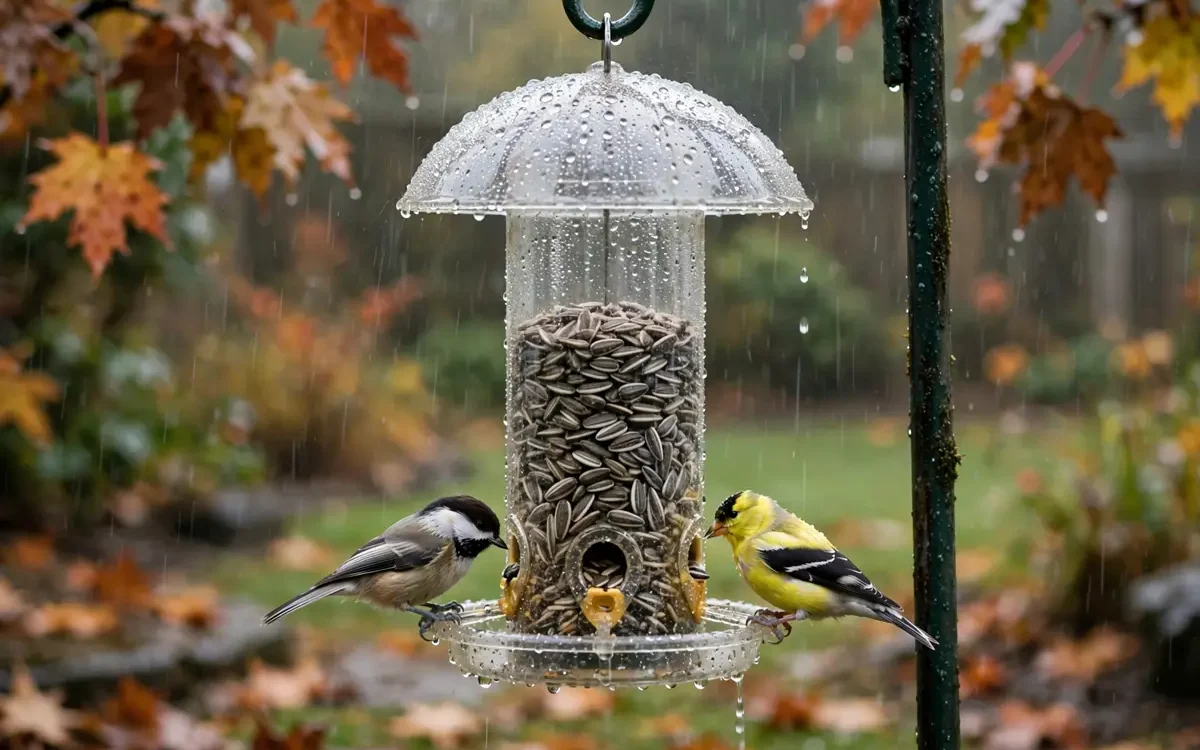
October rain is a gift for the garden and a hazard for the feeder. The first real fall storms roll through, and the seed sitting in your feeders turns into a soggy sponge within hours. Wet seed is not just unpleasant to look at. Damp seed grows mold fast, and moldy seed can sicken the birds you are trying to help. If you want to keep bird seed dry this fall, you need a plan before the storms arrive, not after them.
I learned this lesson the wet way. One rainy October, I tipped my tube feeder to top it off and a solid clump of gray, sour-smelling seed slid out in one piece, like wet concrete. The chickadees had stopped visiting days earlier, and I had assumed the season was simply changing. It was not the season. It was my feeder. A week of steady rain had soaked the seed through, and the birds had quietly decided my yard was no longer a safe restaurant.
That was the year I rebuilt my whole fall routine. What follows are the seven proven tips I use now, every October, to keep seed dry from the first storm through the first frost — plus three storage tricks most feeding guides never mention. If you are new to feeding, my beginner feeding guide covers the basics. This post goes deeper on the one fall problem nobody talks about enough.
🌧️ The Dry-Seed System at a Glance
- Weather guard over every feeder — rain never reaches the seed
- Drainage — every feeder must drain faster than rain falls in
- Half fills — seed eaten in 48 hours never gets the chance to mold
- Indoor airtight storage — mold often starts in the bag, not the feeder
- Scrub after storms — the 10-minute habit most people skip
- Hulled seed + suet in the wettest weeks
- Natural cover — let the porch or evergreens do the work
Plus: the freezer trick, the bay-leaf trick, and the morning-dew fix — below.
📋 In This Guide
1Put a Weather Guard Over Every Feeder
A weather guard is the single most effective tool you can buy for this job. It is a wide, dome-shaped baffle that hangs above the feeder like a small umbrella, and it intercepts rain before it ever reaches the seed. Most guards are 12 to 18 inches across, which gives a tube or hopper feeder a real dry zone even in a slanting rain.
Installation takes five minutes. Slide the guard onto the hanging wire so it sits 6 to 10 inches above the feeder and stays level, so water runs off evenly instead of pooling.
I run guards over all three of my seed feeders from September through April, and the difference is dramatic. Seed that used to clump within a day of rain now stays loose and pourable for days. A guard also keeps wet leaves and droppings off the tray, a quiet bonus for hygiene. It is the cheapest way to keep bird seed dry, and it works the day you hang it.
2Choose Feeders With Real Drainage
Rain will find a way in no matter what you do, so give it a way out. A feeder that drains fast is a feeder that dries fast, and dry seed is safe seed.
On tube feeders, check the bottom cap. Good tubes have drainage slots or a raised screen in the base so water runs out instead of pooling. If yours has a solid bottom with no openings, drill a few small holes yourself. A damp tube with no drainage becomes a mold factory at the bottom.
Tray and platform feeders need drainage even more, since rain falls straight into the open tray. Choose a tray with a mesh floor, or drill quarter-inch drainage holes across a solid one. I also tilt my platform feeders a few degrees with a small shim under one edge so water runs off instead of pooling.
3The 48-Hour Fill Rule
This one is a mindset shift, and it costs nothing: in fall, a half-full feeder beats a full feeder every time.
Seed buried deep inside a tube or hopper never sees daylight and never dries between rains. Fill a tube to the brim in early October, and the bottom half will still be damp a week later, quietly growing mold under fresh seed. Fill it halfway instead, and the whole column gets eaten in two to three days, before the next storm can soak it.
Here is the math I actually use: fill amount = what your birds eat in 48 hours. Watch one full feeder for two days. If a tube empties in three days, fill it two-thirds. If your tray empties daily, fill it daily. When a rainy week is forecast, drop to one-third full and top up every other day. Seed that is eaten within 48 hours never gets the chance to go bad — that is the entire secret.
4Store Your Bulk Seed Bone-Dry Indoors
All the feeder tricks in the world cannot save seed that arrives already damp. Mold often starts in the bag or bin long before the seed ever reaches your feeder, especially in the humid weeks of early fall.
Store seed inside the house, garage, or shed, never outside and never on damp concrete. Move it out of the paper bag the day you buy it and into an airtight container with a snap-tight lid. For bulk buying, a metal trash can with a tight lid is the classic choice, and it keeps mice and squirrels out too.
Buy seed the way you buy fresh groceries: it should smell clean and nutty, not musty or sour. Old, stale seed goes bad much faster once wet, so buy smaller bags more often in fall. My bird seed buying guide breaks down which seeds stay fresh longest and which filler-heavy mixes are barely worth the bag they come in.
5Empty and Scrub Feeders After Every Heavy Rain
After a soaking storm, do not just top off the feeder. Dump it, check it, and scrub it. This is the most important habit in this whole list, and it is the one most people skip.
Here is my after-storm routine, about ten minutes per feeder. Dump any clumped or damp seed in the trash, not on the ground, and rake up the hulls underneath too, because wet ground waste breeds mold where ground feeders forage. Then scrub with hot soapy water, soak ten minutes in a one-part-bleach-to-nine-parts-water solution, rinse thoroughly, and let it dry completely in the sun before refilling.
Moldy or decomposing seeds and hulls can make birds sick, and feeders that stay damp between rain become disease transmission points. Cornell Lab guidance, published through Audubon, says to clean seed feeders about once every two weeks, and more often during heavy use and wet weather. A rainy October is exactly that kind of time. My walkthrough on how I clean my bird feeders covers the full process step by step, including the tools that make it fast.
6Switch to Hulled Seed and Suet During the Wettest Weeks
When the forecast shows a solid week of rain, change what is in the feeders instead of fighting the weather. Some foods simply handle wet conditions better than others.
Hulled sunflower seed, sold as no-mess or no-waste seed, is my top rainy-week pick. No hulls means nothing to trap moisture and form a soggy mat, and birds eat every kernel, so nothing sits long enough to mold. A hulled-sunflower tray feeder empties itself fast and stays clean doing it.
Suet is the other wet-weather champion. A suet cake in a wire cage barely notices rain: water runs off, the cake dries in minutes, and it delivers the high-fat energy birds need as temperatures drop. Woodpeckers, nuthatches, chickadees, and wrens all hammer suet in October, even while seed feeders are closed for cleaning.
Knowing what backyard birds actually eat helps you pick the right rainy-week foods. That is why my best winter bird food guide ranks high-fat, weather-resistant foods at the top.
7Move Feeders Under Natural Cover
The oldest trick in this list is also the most overlooked. Hang your feeders where something above them already blocks the rain.
A feeder tucked under a porch or shed eave stays remarkably dry in steady rain: sheltered from above, open on the sides so birds can spot danger. A dense evergreen canopy works the same way. I keep one feeder just inside the drip line of a large spruce, and the needles knock down at least half of every rainfall before it reaches the tube.
Two cautions. First, keep feeders a few feet out from walls and windows, so birds are not flying into glass in poor visibility. Second, sheltered spots can become stale spots: a feeder under a porch never gets a sunbath, so check it for mold just as often as the exposed ones.
Feeders near cover are feeders where birds feel safe, and safe birds visit more often and stay longer. If your feeders went quiet when the rains started, a dry, clean feeder under cover is often the fix. When birds still stay away, run through the other suspects in my guide to why birds are not coming to your feeder. Wet seed is common, but it is not the only culprit.
🧪 3 Storage Tricks Almost Nobody Mentions
These three go beyond the standard advice, and each one solves a problem most feeding guides ignore.
1. Freeze new seed bags for 48+ hours. Seed moths and weevils often arrive as invisible eggs inside the bag from the store. Sealing the bag and freezing it at 0°F for at least 48 hours (a full week is the gold standard per pest-control guides like Dr. Killigan’s) kills eggs and larvae before they hatch in your storage bin. Freezing does not harm the seed’s nutrition — bird keepers do this routinely, and the seed still sprouts fine afterward. Let the bag return to room temperature before opening, so condensation does not form on cold seed.
2. Drop a bay leaf in the bin. Pantry moths and weevils dislike the scent of bay leaves (the compound eucalyptol is a known insect repellent). Tuck one or two dried bay leaves into your seed storage container — a trick borrowed from kitchen pantries that almost no bird-feeding guide mentions. Replace the leaves every month or two as the scent fades. It will not rescue an already-infested bin, but it makes a clean bin less inviting.
3. Add a food-safe desiccant pack. Those little silica gel packets that come in shoe boxes? Food-safe versions exist, and tossing one into your seed bin absorbs the ambient humidity that seeps in every time you open the lid in damp fall air. One pack per 10-pound bin, replaced monthly, keeps the storage microclimate dry between openings.
Which Foods Survive a Wet Week?
| Food | Wet-Weather Rating | Why |
|---|---|---|
| Suet | ⭐⭐⭐⭐⭐ | Water runs off the cake; dries in minutes |
| Hulled sunflower | ⭐⭐⭐⭐ | No hulls to trap moisture; eaten fast |
| Peanuts (in shell) | ⭐⭐⭐⭐ | Shell protects the kernel; mesh feeder drains |
| Black oil sunflower | ⭐⭐⭐ | Fine with a weather guard; clumps without one |
| White proso millet | ⭐⭐ | Absorbs water on the ground; use tray with drainage |
| Nyjer seed | ⭐⭐ | Clumps when wet; goes stale fast |
| Cracked corn | ⭐ | Turns to paste in rain — skip it in wet weeks |
🍂 Your Dry-Seed Fall Routine
None of these tips is complicated on its own. Together they turn October from your soggiest feeding month into one of the best:
- Guards over every feeder, hung level
- Drainage checked on every feeder before the rains
- 48-hour fills — never more than birds eat in two days
- Freeze new bags 48+ hours, then store airtight indoors with a bay leaf
- Scrub every feeder after heavy rain — 10 minutes each
- Hulled seed + suet when the forecast turns ugly
- Cover — porch eaves, evergreens, morning sun
Here is the payoff nobody mentions: the birds that learn your feeders stay dry and mold-free in October are the ones that will trust your yard all winter. Fall is when your winter regulars decide which gardens are worth sticking around for. A clean, dry feeder in a rainy October is how you keep bird seed dry and earn their loyalty at the same time.
When the first frost arrives and the wet season gives way to the cold one, your winter feeding plan takes over. My best winter bird food guide picks up right where this post leaves off, with the high-energy foods that carry birds through the hardest months. Get the wet season right first, and the winter flock will follow.
Frequently Asked Questions
How fast does wet bird seed grow mold?
Mold can start within a few days in warm, damp conditions, faster in hot, humid weather. That is why the 48-hour fill rule — fill halfway, shake-test daily, and scrub after heavy rain — beats letting a full feeder sit through a wet week.
Can birds get sick from eating wet, moldy seed?
Yes. Moldy or decomposing seeds and hulls can make birds sick and turn feeders into disease transmission points. If seed smells musty, shows webbing or gray dust, or has clumped solid, throw it away — no amount of drying makes it safe.
Should I take down my feeders during rainy weeks?
No, there is no need to stop feeding. Add a weather guard, fill feeders only halfway, and refill more often. Birds need the energy, and a dry, clean feeder in a rainy week is exactly what keeps your regulars coming back.
What is the best bird feeder for rainy weather?
A tube or hopper feeder with a domed weather guard above it and real drainage at the bottom — drainage slots or a screen base on tubes, mesh floors on trays. Fill it only a third to halfway full during rainy weeks and clean it after storms.
How should I store bulk bird seed in fall?
Freeze new bags for 48+ hours to kill insect eggs, then move seed into an airtight container with a snap-tight lid (a gasket-seal bin or metal trash can), keep it indoors off damp floors, and buy smaller bags more often. A dried bay leaf in the bin helps deter pantry moths. If stored seed smells musty or shows mold, discard the whole batch.
Does freezing bird seed harm its nutrition?
No. Freezing at 0°F kills insect eggs and larvae but does not damage the seed’s nutritional value — the seed can still sprout afterward. Let the bag return to room temperature before opening so condensation does not form on the cold seed.

Related Articles
Why Do Birds Throw Seed Out of the Feeder? (And How to Stop It)
Last fall I stood under my tube feeder, stared at the two-inch carpet of seed and husks on…
Read Article
Do Bird Feeders Make Birds Dependent? The Honest Answer (2026)
Last February, watching a downy woodpecker work my suet feeder in a sleet storm, the guilty thought crossed…
Read Article
How to Keep Starlings Away From Bird Feeders: 7 Proven Tips (2026)
Bird Feeding Note: This article is for general informational purposes. Keep feeders clean, provide fresh food and water,…
Read Article