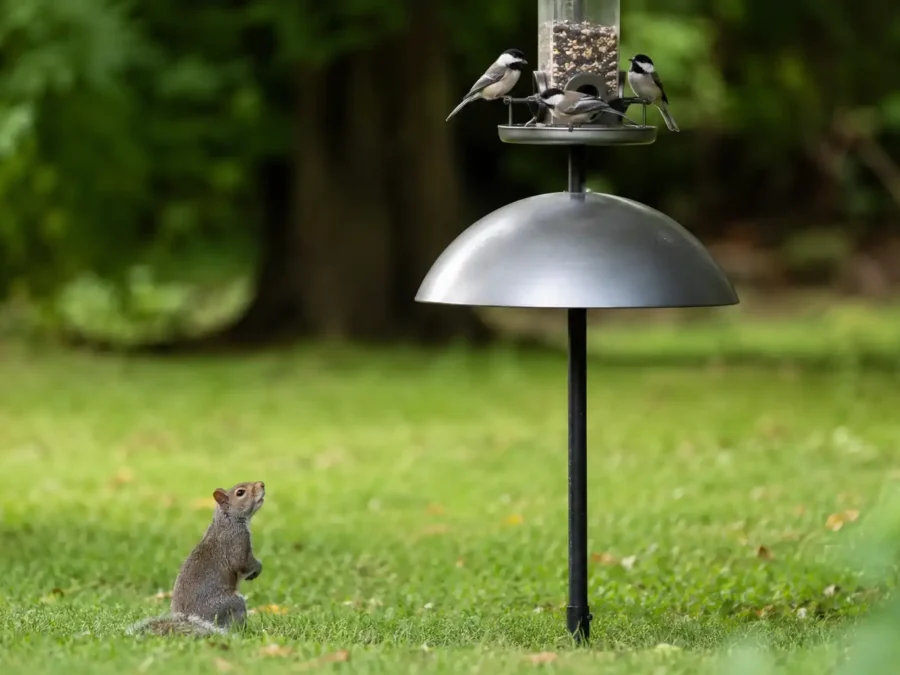
Let me be honest about squirrel-proof bird feeders before we start — and this honesty is exactly what the top-ranking guides get right: there is no such thing as a 100% squirrel-proof bird feeder. Squirrels are acrobatic, persistent, problem-solving rodents with nothing but free time. One squirrel defeated a “squirrel-proof” feeder in eleven minutes.
But here’s the good news: you don’t need perfection. You need friction. Stack 3–4 of the methods below and squirrel raids drop from daily devastation to rare entertainment. That’s a win.
🐿 The Squirrel Defense, Up Front
- No feeder is 100% squirrel-proof — but stacked defenses turn daily raids into rare entertainment.
- Baffle + 10-foot placement is the highest-ROI defense you can buy.
- Safflower seed removes the reward; spill management removes the buffet underneath.
- The winning stack: baffle + 10-foot clearance + safflower + weekly raking — under $50.
7 proven methods below, plus what doesn’t work (save your money).
📋 In This Guide
1Method 1: The Baffle (Highest ROI)
A baffle is a cone or dome guard mounted on the feeder pole — and it’s the single most effective dollar-for-dollar defense in existence.
How to install it right (this is where people fail):
- Pole-mounted feeders: cone baffle below the feeder, top of the baffle at least 4–5 feet off the ground (squirrels jump ~4 feet vertically)
- Hanging feeders: dome baffle above the feeder
- The 10-foot rule: pole must be 10+ feet from trees, roofs, fences, or anything launchable — squirrels jump 8–10 feet horizontally
- Keep the baffle clean and wobble-free; a wobbly baffle is actually better (squirrels can’t grip it)
Cost: $15–30. Effectiveness: the closest thing to a silver bullet.
2Method 2: Weight-Activated Feeders
Feeders like the Brome Squirrel Solution or Droll Yankees Yankee Flipper use the squirrel’s own weight against it — ports snap shut (or the perch spins!) when anything heavier than a large songbird lands. Birds feed normally; squirrels get frustrated.
- Pros: genuinely effective, entertaining to watch, no installation geometry needed
- Cons: pricier ($60–150), heavier birds like jays can occasionally trigger them, need regular cleaning around the mechanism
- Best practice: pair one weight-activated feeder with a baffle on a pole setup to cover 90% of scenarios
3Method 3: Safflower Seed (The Quiet Weapon)
Squirrels, grackles, and starlings find safflower seed bitter. Cardinals, grosbeaks, chickadees, and doves love it. Many birders report that converting one hopper to 100% safflower makes squirrel visits to that feeder fall off a cliff — while the cardinals never leave.
It won’t stop a determined squirrel from checking, but it removes the reward. No reward, no repeat visits. Details: best bird food for backyard birds.
4Method 4: Pole Placement Geometry
Squirrels are bound by physics, even if they don’t know it:
- 10+ feet from any launch point (tree, deck rail, roof, fence)
- 5+ feet off the ground (pole height, plus baffle below feeder)
- No nearby “highways” — prune branches that overhang within 10 feet
- Use a smooth metal pole (1″ diameter is hard to climb); avoid wood posts, which are squirrel ladders
Get this geometry right and even a basic feeder becomes surprisingly defensible.
5Method 5: Cage-Style Feeders
Tube feeders wrapped in a metal cage let small birds (finches, chickadees) slip through while locking out squirrels and large bully birds. The trade-off: cardinals and jays can’t use them either, so run a caged feeder alongside an open one, not instead of it.
6Method 6: Spill Management
Half of squirrel attraction isn’t the feeder — it’s the buffet underneath. Fallen seed, hulls, and shells are a 24-hour rodent restaurant.
- Use seed trays under feeders to catch spillage
- Rake weekly under feeding stations
- Never overfill — put out what birds eat in a day or two
- Store seed in sealed metal containers (squirrels chew through plastic; mice too)
Bonus: less ground waste also means less disease risk. Win-win — see how to clean your bird feeders.
7Method 7: The Dedicated Squirrel Feeder (Strategic Surrender)
Counter-intuitive but effective: put a cheap corn-cob feeder for squirrels far from your bird feeders (30+ feet). It doesn’t eliminate raids, but a squirrel with its own easy meal is a squirrel less motivated to engineer a pole assault. Think of it as a peace treaty with terms favorable to you.
- Greasing the pole — washes off, can coat bird feathers and squirrel fur (harmful), needs constant reapplication
- Cayenne pepper / hot sauce in seed — the evidence is mixed at best; capsaicin doesn’t deter birds (they can’t taste it) but determined squirrels often power through, and concentrated pepper dust can irritate birds’ eyes and your own lungs
- Ultrasonic repellers — no credible evidence they work on squirrels
- Relocating squirrels — illegal in many areas, ecologically harmful, and a new squirrel moves into the territory within days
Squirrel-Proof Bird Feeders Compared
| Method | Cost | Effectiveness | Effort |
|---|---|---|---|
| Baffle (correctly installed) | $15–30 | ★★★★★ | One-time setup |
| Weight-activated feeder | $60–150 | ★★★★☆ | Buy & hang |
| Safflower seed | ~same as seed | ★★★★☆ | Just switch bags |
| Pole geometry (10ft/5ft) | Free–$30 | ★★★★☆ | One-time setup |
| Cage feeder | $30–60 | ★★★☆☆ | Buy & hang |
| Spill management | Free | ★★★☆☆ | Weekly habit |
| Squirrel feeder (diversion) | $10–20 | ★★☆☆☆ | Supplemental |
The winning stack: baffle + 10-foot placement + safflower in one feeder + weekly raking. That’s under $50 and solves the problem for most yards.
Squirrel-Proof Bird Feeders: FAQs
What is the most squirrel-proof bird feeder?
Weight-activated feeders (Brome Squirrel Solution, Droll Yankees Yankee Flipper) combined with a properly installed baffle and 10-foot clearance come closest. No feeder alone is 100% squirrel-proof — it’s the system that works.
Does cayenne pepper keep squirrels off bird feeders?
Not reliably. Birds can’t taste capsaicin but squirrels often tolerate it, and pepper dust can irritate birds’ eyes. Safflower seed and baffles are more effective and safer.
How far can squirrels jump to reach a feeder?
About 8–10 feet horizontally and 4 feet vertically. That’s why the 10-foot clearance rule and 4–5-foot baffle height matter — they exploit the squirrel’s physical limits.
Will a baffle work on a hanging feeder?
Yes — use a dome/wrap-around baffle above the hanging feeder, and make sure the branch or hook it’s hung from is 10+ feet from any launch point. Squirrels can also chew through hanging wires, so use metal.
Do squirrel-proof feeders also block large birds?
Cage-style feeders do (cardinals and jays can’t enter). Weight-activated feeders may occasionally trigger under heavy jays but generally work fine. Run a caged feeder alongside an open platform feeder to serve everybody.
Should I just feed the squirrels separately?
A diversion feeder 30+ feet from bird feeders reduces (not eliminates) raids. It works best as a supplement to baffles and placement — not as the only strategy.
Now that your seed is safe: dial in feeder placement, stock the best bird food, and invite cardinals — the birds squirrels can’t scare off.

Related Articles
Why Do Birds Throw Seed Out of the Feeder? (And How to Stop It)
Last fall I stood under my tube feeder, stared at the two-inch carpet of seed and husks on…
Read Article
Do Bird Feeders Make Birds Dependent? The Honest Answer (2026)
Last February, watching a downy woodpecker work my suet feeder in a sleet storm, the guilty thought crossed…
Read Article
How to Keep Bird Seed Dry in Fall: 7 Proven Tips (2026)
Bird Feeding Note: This article is for general informational purposes. Keep feeders clean, provide fresh food and water,…
Read Article