
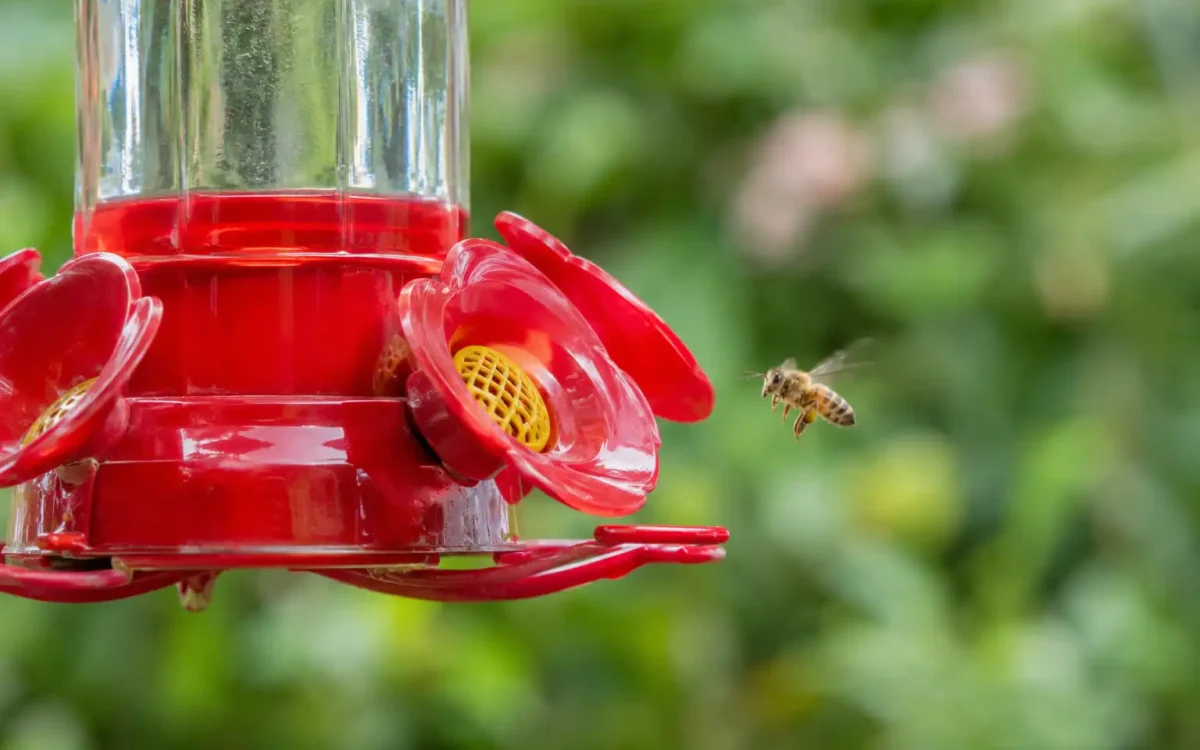
Most people assume the bright red parts of a hummingbird feeder are what’s drawing bees and wasps in — the actual culprit is a completely different color, and it has nothing to do with the nectar’s flavor either. Learning how to keep bees and wasps away from a hummingbird feeder starts with understanding what’s really pulling them in, because most of the advice built around red dye and nectar strength misses the point entirely. This guide covers what genuinely works, without resorting to anything that could harm the insects or the birds sharing the same backyard.
Why Bees and Wasps Show Up in the First Place
Sugar is the entire explanation. A hummingbird feeder is essentially a concentrated sugar source sitting out in the open, and any insect that feeds on nectar or sweet liquids will eventually find it, especially during warmer months when natural flower nectar becomes scarcer across the yard.
Leaks and drips make the problem noticeably worse. A feeder with even a small crack or loose seal lets sugar water reach the outside of the feeder, which turns a merely tempting target into an unmissable one.
Why Do Bees Like Yellow Hummingbird Feeder Parts
This is where most advice gets it backward. Hummingbirds are drawn to red, but bees and wasps are evolutionarily wired to notice yellow, since it closely resembles the color of many nectar-rich flowers they already forage from.
Feeders with yellow feeding ports or yellow bee guards, ironically, tend to attract more insects rather than fewer. Choosing a feeder without yellow components, or covering any yellow parts with tape, removes a visual cue that has nothing to do with the sugar water itself and everything to do with color recognition. Many manufacturers still default to yellow ports simply because it’s a common, low-cost material color, not because it offers any benefit to the birds.
Bee Guards for Hummingbird Feeders
Bee guards for hummingbird feeders are small mesh or cage-like attachments that fit over each feeding port. They’re sized to let a hummingbird’s long, narrow tongue through while physically blocking a bee or wasp’s shorter mouthparts from reaching the nectar.
Most modern feeders include these by default, but they can also be purchased separately if an existing feeder lacks them. It’s worth checking that any replacement guard is actually compatible with the specific feeder model, since fit varies between brands, and a poorly fitted guard can leave gaps large enough for smaller wasps to squeeze through anyway.
Saucer Style Hummingbird Feeder for Bees
A saucer style hummingbird feeder for bees works differently than a typical bottle-style design. Instead of nectar sitting right at the feeding ports, it’s held in a shallow reservoir below, out of reach for anything with short mouthparts.
Hummingbirds can still access the nectar easily thanks to their long tongues, while bees and most wasps simply can’t reach far enough down. Saucer feeders also tend to be easier to clean thoroughly, which helps with the leak-and-residue problem covered earlier, since the wider opening makes it simpler to scrub every corner by hand.
Natural Ways to Keep Wasps Away From a Hummingbird Feeder
Among the more effective natural ways to keep wasps away from a hummingbird feeder is setting up a decoy feeder specifically for insects. A second, less sugary feeder filled with a weaker sugar-water mix and placed at least ten feet away redirects attention without harming anything, and it tends to work especially well once wasps have already established a feeding pattern at the main feeder.
Moving the main feeder just three or four feet from its original spot can also throw off insects that have already mapped its location, since bees and wasps rely heavily on memorized routes. Hummingbirds, by contrast, tend to relocate their attention just as easily and usually find the new spot within a day or two.
Placement and Shade Make a Real Difference Too
Positioning matters more than most people realize. Hanging a feeder away from flowering plants, where bees are already actively foraging, reduces the odds of it being noticed in the first place, simply by keeping it outside their usual patrol area.
Shade also plays a role. A feeder placed under a tree or awning tends to draw fewer insects than one in full sun, partly because bright, sun-warmed nectar tends to ferment and become more fragrant faster, which makes it more noticeable to foraging insects nearby.
Timing Matters More Than It Seems
Insect activity tends to peak during the warmest part of the afternoon and drop off noticeably in early morning and evening, when hummingbirds themselves are often most active anyway. Refilling a feeder during those quieter windows, rather than at midday, gives birds a head start before insects fully wake up for the day.
Late summer tends to bring the worst of it, since wasp colonies are at their largest by that point in the season and natural food sources are starting to thin out. Being slightly more vigilant with cleaning and placement during that stretch tends to prevent most problems before they escalate into something harder to manage.
Cleaning and Leaks: Where This Problem Actually Starts
Since sticky residue and drips are what escalate a mild insect visit into a real infestation, keeping a feeder genuinely clean matters more than most people expect. Our full guide on how to clean a hummingbird feeder covers exactly how to keep one free of the buildup that draws insects in.
Leaked or spilled nectar around the base of a pole causes a nearly identical problem with ants, which is why our guide on how to keep ants out of a hummingbird feeder shares so much overlap with this one — a tight seal and a regular cleaning habit solve both issues at once, without needing two completely separate routines.
Common Myths, Sorted From Fact
A few pieces of common advice deserve a closer look before assuming they’re accurate:
| Myth | Fact |
|---|---|
| Red nectar keeps bees away | Nectar color makes no real difference; dye isn’t necessary at all |
| Stronger nectar attracts more insects | The standard ratio, prepared correctly, is fine either way |
| Pesticides are the fastest fix | They risk harming hummingbirds and declining pollinator populations |
Our guide on how to make hummingbird nectar covers the correct ratio in more detail, including why dye was never necessary in the first place.
A relative of mine had all but given up on her hummingbird feeder one summer after wasps essentially took it over, chasing off every bird that tried to approach. She was ready to take the feeder down entirely until someone suggested the decoy trick.
She filled an old feeder with a much weaker sugar mix, hung it near the fence line well away from the main feeder, and within a few days the wasps had mostly relocated their attention there instead. It wasn’t instant and it wasn’t perfect, but the hummingbirds came back to the main feeder within about a week, which was more than she expected from something that simple. She still keeps the decoy feeder up every summer now, mostly as a precaution rather than waiting for the problem to return first.
Frequently Asked Questions
Will bees hurt hummingbirds at a feeder?+
Direct harm is rare, but a large number of bees or aggressive wasps can crowd a feeder enough that hummingbirds avoid it entirely, which is really the more common problem.
Should I use a bee guard on my hummingbird feeder?+
Yes, if the feeder doesn’t already include one. Bee guards are a simple, low-effort way to physically block insects without affecting how hummingbirds feed.
Does red hummingbird nectar attract bees?+
No, nectar color has little to do with it. Bees and wasps respond far more to yellow feeder components and to any sugar residue or leaks around the feeder itself.
Can I use vinegar to keep bees away from a hummingbird feeder?+
A light vinegar wipe on the outside of the feeder or pole can help mask sugary residue, but it should never come into contact with the nectar itself or the feeding ports.
Why do wasps keep coming back to my hummingbird feeder?+
Wasps remember reliable food sources and will keep returning until that source is removed, blocked, or replaced with a more appealing alternative like a decoy feeder placed elsewhere.
Worth a second look before doing anything drastic
Before reaching for anything stronger, it’s worth checking a feeder for yellow parts, leaks, or a spot too close to where bees already forage. Most people trying to solve how to keep bees and wasps away from a hummingbird feeder find that one of these small details was the actual issue all along, not the nectar itself, and fixing it rarely takes more than an afternoon.
Mastering how to keep bees and wasps away from a hummingbird feeder is mostly about removing what attracts them — sweetness on the feeder’s exterior, yellow parts, and leaky seams. To keep bees and wasps away without harming pollinators, the Audubon Society’s bird-friendly yard guide and Cornell Lab’s All About Birds both emphasize habitat over chemicals.
How to Keep Bees and Wasps Away From a Hummingbird Feeder: Key Takeaways

Related Articles
How to Attract Orioles to Your Backyard (Complete Guide)
A lot of people assume that if hummingbirds are already visiting their yard, orioles will simply show up…
Read Article
How to Attract Birds With Water (Complete Bird Bath Guide)
Last updated: September 24, 2026 · 7 min read Here’s something the seed companies won’t tell you: a…
Read Article
DIY Hummingbird Feeder: Easy Builds From Things You Already Have
An empty mason jar sitting in the recycling bin was the entire reason this turned into a project…
Read Article